Compare
Joomla vs Drupal: Performance and Usability Compared
⚡ Quick Answer
Joomla is faster out of the box and needs far less server tuning to feel snappy. Drupal can match or exceed that speed at large scale, but only once you add proper caching layers like Varnish and Redis. For small-to-mid traffic sites, Joomla gets you there faster; for complex, high-traffic, or API-driven projects, Drupal's caching architecture scales further with the right infrastructure investment.
This comparison covers Joomla 6 and Drupal 11 as of mid-2026: out-of-the-box speed, how each platform caches content, server and hosting requirements, and which one scales better under heavy traffic. All specs below come from the official Joomla and Drupal documentation and independent CMS comparisons published in 2026.
Joomla vs Drupal Speed: What Independent Tests Show
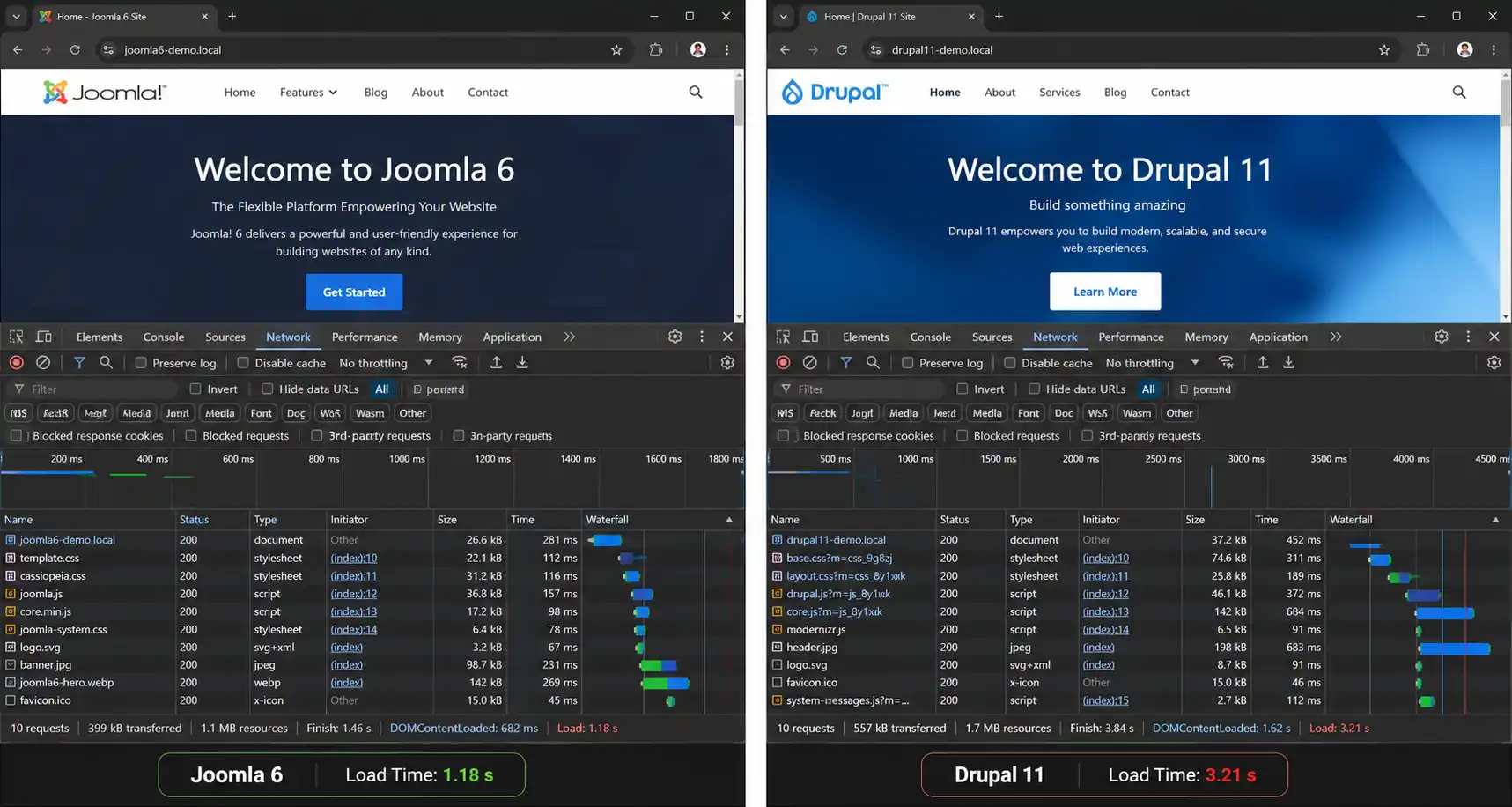
Across several independent CMS comparisons run in 2026, Joomla consistently comes out ahead on first-load speed. Testers describe Joomla as fast "from the very first click," while Drupal tends to need a caching layer or a couple of repeat visits before it reaches its full speed potential.
The gap isn't really about raw engine speed — it's about effort. Joomla reaches "good performance" quickly with minimal configuration. Drupal can outperform Joomla at scale, but only once a team invests in proper caching and hosting infrastructure. Without that investment, Drupal's larger dependency footprint tends to make it feel heavier during initial loads.
Caching Architecture: Built-in Simplicity vs Layered Power
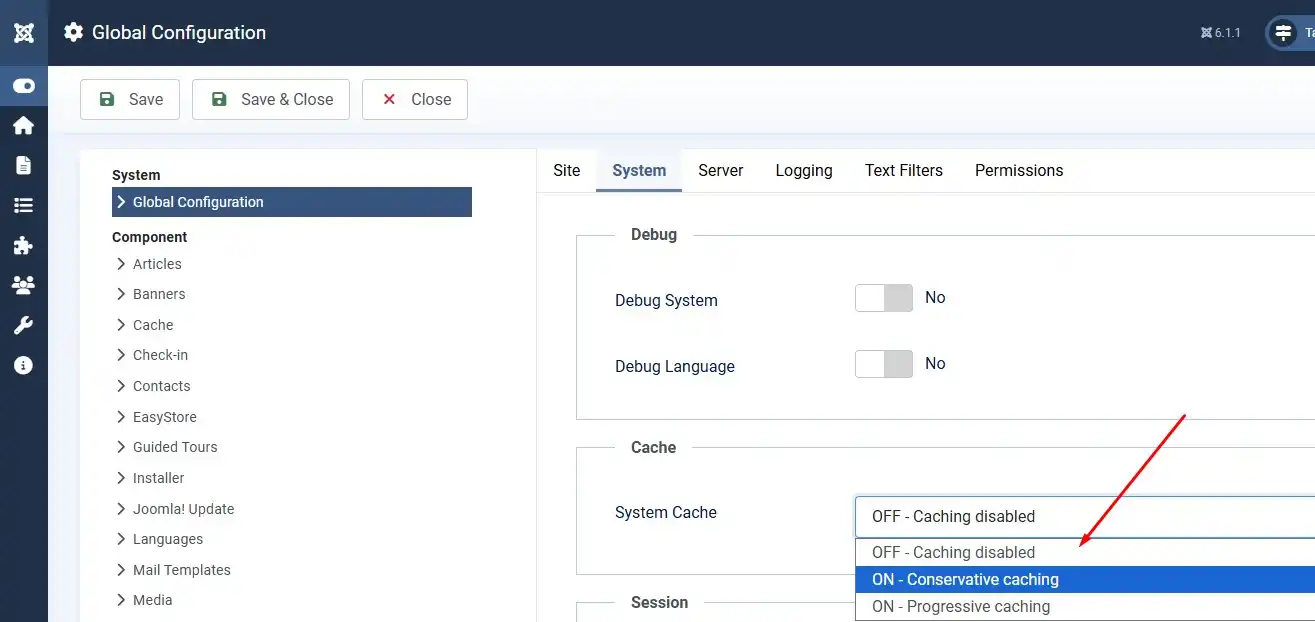
Joomla ships with page caching, conservative caching, and Gzip compression that you can switch on directly from Global Configuration — no extra services to install. This is a big part of why Joomla feels quick with little setup.
Drupal also includes internal page caching and dynamic page caching out of the box, but production sites usually add two external layers to reach comparable or better speed at scale:
- Varnish — an HTTP reverse proxy that serves cached pages before they ever reach Drupal, using cache tags for targeted invalidation instead of clearing the whole cache on every change.
- Redis or Memcache — in-memory object caching that speeds up database queries and configuration lookups behind the scenes.
In short: Joomla's caching is simpler and self-contained. Drupal's caching is more powerful once assembled, but assembling it is extra work.
Server & Hosting Requirements Compared (2026)
| Requirement | Joomla 6 | Drupal 11 |
|---|---|---|
| Minimum PHP | 8.3.0 | 8.3 |
| Recommended PHP | 8.4+ | Latest supported 8.3.x branch |
| Minimum database | MySQL 8.0.13 / MariaDB 10.4 | MySQL 8.0 / MariaDB 10.6 / PostgreSQL 16 / SQLite 3.45 |
| Recommended database | MySQL 8.4+ / MariaDB 12.0+ | Not officially specified — use latest supported version |
| Minimum RAM | Recommended PHP memory_limit ≥ 256MB | 1GB (mainly to run Composer reliably) |
| Extra tooling required | None | Composer 2.7.0+ for install/updates |
| Caching add-ons needed at scale | None — built-in cache is usually enough | Varnish + Redis/Memcache recommended |
[CẦN BẠN XÁC NHẬN: nếu bạn có số liệu RAM tối thiểu thực tế đo trên server đang dùng để host Joomla/Drupal, thêm vào bảng này để cụ thể hơn thay vì chỉ dựa vào tài liệu chính thức.]
Scalability: Which CMS Handles High Traffic Better?
For very large deployments, Drupal is generally viewed as the stronger choice for performance and scalability — it's been used to run large university and enterprise portals handling heavy simultaneous traffic. Joomla performs well for small-to-mid-sized businesses but can struggle to absorb an extremely large number of concurrent visitors without significant customization.
That scalability comes with a cost: Drupal needs proper DevOps maturity to get there. Once its caching and hosting are set up correctly, it becomes a genuinely capable platform at enterprise scale. Joomla trades some of that ceiling for a much shorter path to "fast enough."
⚠️ Don't confuse "can scale" with "scales by default"
Drupal's enterprise-grade ceiling only shows up after you add Varnish and Redis/Memcache and size your hosting correctly. A default Drupal install on budget shared hosting will often feel slower than a default Joomla install on the same hosting.
Which CMS Should You Choose for Performance?
| Project type | Better performance fit |
|---|---|
| Small business site, blog, portfolio | Joomla — fast with minimal server tuning |
| Mid-sized site with moderate traffic | Joomla — built-in caching is usually enough |
| Enterprise, government, or university portal | Drupal — with Varnish + Redis/Memcache in place |
| Structured/API-driven content (decoupled front end) | Drupal — content modeled as queryable data |
❓ FAQ
Is Joomla faster than Drupal out of the box?
Yes. Independent 2026 comparisons found Joomla renders quickly from the first load, while Drupal typically needs a caching layer or repeat visits to reach its full speed.
What PHP version does Joomla 6 require?
Joomla 6 requires PHP 8.3.0 as a minimum, with PHP 8.4 or later recommended for best performance and security.
What PHP version does Drupal 11 require?
Drupal 11 requires PHP 8.3. Running the latest supported point release of that branch is recommended to keep receiving security fixes.
Do I need Redis or Varnish to run Drupal?
Not to install it, but production sites at real scale usually add Varnish for page caching and Redis or Memcache for object/database caching to reach speeds comparable to Joomla's built-in cache.
Which CMS scales better for high traffic?
Drupal is generally considered the stronger choice for very large or enterprise-scale traffic once proper caching infrastructure is in place. Joomla handles moderate traffic well without extra tuning.
Is Joomla or Drupal better for a small business site?
Joomla, in most cases — it reaches good performance faster with less server configuration, which suits teams without dedicated DevOps support.
⚖️ Final Verdict
If you want a site that feels fast right after installation and you don't have a DevOps team on hand, Joomla is the more practical performance choice in 2026. If you're building for enterprise scale, expect very high traffic, or need content modeled as structured data for APIs and decoupled front ends, Drupal's ceiling is higher — provided you budget for Varnish, Redis or Memcache, and hosting that can support them.
✅ Last verified against Joomla 6.1 and Drupal 11 — July 2026

Thanh Le
Joomla Specialist & Technical Writer
Thanh Le is a Joomla expert and technical writer at Jlvextension.com, known for creating in-depth tutorials, extension reviews, and optimization guides. His work focuses on helping developers and webs
How to Override a Module Layout in Joomla 6 (Update-Safe Method)
Beginner
⏱ 5 min

Joomla Security Checklist: 12 Steps to Harden Your Site in 2026
Beginner
⏱ 11 min