Tutorial
How to Add Google Analytics 4 to Joomla (2026 Guide): 3 Methods, No Coding Required
Quick Answer
To add Google Analytics 4 to Joomla, create a GA4 property in Google Analytics to get a Measurement ID (starts with G-), then install it using a free Joomla plugin such as a "Custom Code to Head" or "Easy Google Analytics" plugin — no template editing needed. This works on any Joomla 4, 5, or 6 site regardless of template.
| What you'll need | Details |
|---|---|
| Joomla admin access | Super User or Administrator role |
| Google account | Free, used to create the GA4 property |
| Joomla version | Works on Joomla 4.x, 5.x, and 6.x |
| Time required | About 10–15 minutes |
| Coding skill | None, for the recommended plugin method |
Universal Analytics stopped processing data in mid-2024, so Google Analytics 4 (GA4) is now the only option for tracking a Joomla site. This guide covers three ways to install it — a no-code plugin method (recommended for most sites), your template's built-in Custom Code field (if your template has one), and a manual template edit for developers — plus how to confirm the tracking code is actually firing.
What Is a GA4 Measurement ID and Where Do You Get It?
Every GA4 property has a Measurement ID that looks like G-XXXXXXXXXX. This is the code your Joomla site needs to send data to Google Analytics. Here's how to get it:
- Go to analytics.google.com and sign in with your Google account.
- Click Admin (gear icon, bottom left), then Create Property.
- Enter your site name, time zone, and currency, then click Next and fill in basic business details.
- Under Data Streams, choose Web, enter your Joomla site's URL and a stream name, then click Create stream.
- On the stream details screen, copy the Measurement ID — this is what you'll paste into Joomla in the next step.
🖼️
SCREENSHOT NEEDED
Google Analytics 4 admin panel, Data Streams screen, with the Measurement ID field visible and circled in red
Measurement ID vs. Stream ID
Copy the code that starts with G- (Measurement ID), not the numeric Stream ID shown below it. Pasting the wrong one is the single most common reason GA4 shows no data after setup.
Which Installation Method Should You Use?
[CẦN BẠN XÁC NHẬN: nếu site đang dùng 1 template thương mại cụ thể (JA, Helix, T3...) mình có thể viết bổ sung bước cụ thể cho template đó]
| Method | Best for | Coding needed | Survives Joomla/template updates |
|---|---|---|---|
| 1. Plugin (recommended) | Most sites, any template | None | Yes |
| 2. Template's Custom Code field | Sites using Helix, T3, or JA-based templates | None | Yes, as long as you keep the same template |
| 3. Manual template edit | Developers using a child template | Basic HTML | Only if edited in a child template, not core files |
If you're unsure which applies to you, start with Method 1 — it works on every Joomla site, including the default Cassiopeia template, which does not have a built-in code field.
Method 1: Add GA4 with a Joomla Plugin (No Coding, Recommended)
This is the safest method because it doesn't touch any template files, so it isn't lost when you update Joomla or switch templates.
- In your Joomla admin, go to System → Manage → Install.
- Search the Joomla Extensions Directory for a free "Custom Code to Head" or "Easy Google Analytics" plugin, download it, then upload and install the ZIP file.
- Go to System → Manage → Plugins and search for the plugin you just installed.
- Open the plugin, paste your GA4 Measurement ID (or the full gtag.js snippet, depending on the plugin) into the field provided.
- Set the plugin's Status to Enabled and click Save & Close.
🖼️
SCREENSHOT NEEDED
Joomla plugin settings screen with the GA4 Measurement ID field filled in and the Status toggle set to Enabled
Method 2: Use Your Template's Custom Code Field
If your Joomla site uses a template built on the Helix, T3, or JA framework (common with JoomShaper, JoomlArt, and similar template clubs), you likely already have a code field built in.
- Go to System → Site Templates → Styles and click your active template style.
- Look for a tab called Custom Code or similar (this tab does not exist on Joomla's default Cassiopeia template).
- Paste the full GA4 gtag.js snippet from Google Analytics into the Head code field.
- Click Save & Close.
- If you use multiple template styles for different parts of your site, repeat this for each style.
Method 3: Manually Edit Your Template's index.php (Advanced Users)
Use a child template
Editing a core template file directly means your changes are overwritten the next time that template updates. Create a child template first, or use Methods 1–2 instead.
- Go to System → Site Templates → Templates and open your child template's files.
- Open
index.phpand locate the closing</head>tag. - Paste the GA4 gtag.js snippet immediately before
</head>. - Save the file and clear your Joomla cache (System → Maintenance → Clear Cache).
How to Verify GA4 Is Actually Tracking Your Joomla Site
Installing the code doesn't guarantee it's working — always confirm before moving on.
- Open your Joomla site in a new browser tab and browse a couple of pages.
- In Google Analytics, go to Reports → Realtime. You should see at least one active user (you) within about 30 seconds.
- Install the free Google Tag Assistant browser extension, revisit your site, and confirm it detects a GA4 tag firing with your Measurement ID.
- If nothing appears, clear your Joomla page cache and any CDN cache, then repeat step 1.
🖼️
SCREENSHOT NEEDED
Google Analytics 4 Realtime report showing at least one active user visiting the Joomla site
Common Mistakes to Avoid
- Pasting a Universal Analytics ID. Any ID starting with
UA-is retired and will never send data — you need theG-Measurement ID from a GA4 property. - Copying the Stream ID instead of the Measurement ID. Both appear on the same screen; only the
G-code goes into Joomla. - Adding the code to the wrong template style. If your site uses more than one template style, the code only applies to the style you edited.
- Editing core template files instead of a child template. The next template update silently removes your tracking code.
- Testing with an ad blocker or strict cookie-consent tool active. These can block gtag.js from firing, making it look like the install failed when it didn't.
- Not clearing cache after installing. A cached version of the page served to you (and to Google) may not include the new code yet.
Frequently Asked Questions
What's the difference between a Measurement ID and a Tracking ID?
A Tracking ID (UA-XXXXXXX) belonged to the retired Universal Analytics. A Measurement ID (G-XXXXXXXXXX) is used by GA4, the current version, and is what your Joomla site needs today.
Do I need a plugin, or can I add GA4 to Joomla manually?
A plugin is not required, but it's the safest option because it survives template and Joomla updates. Manual edits work too, but only if done in a child template rather than core files.
Will adding Google Analytics slow down my Joomla site?
The impact is minimal. The gtag.js script loads asynchronously, so it doesn't block your page from rendering, though every added script does add a small amount of load time.
Can I use Google Tag Manager instead of pasting the GA4 snippet directly?
Yes. You can install the Google Tag Manager container snippet using the same plugin or Custom Code field, then configure the GA4 tag inside Tag Manager instead of hardcoding it in Joomla.
Why does GA4 show no data even after I added the code?
The most common causes are pasting the wrong ID, editing the wrong template style, browser ad blockers, or a page cache serving an old version of the page. Clear your cache and check with Tag Assistant first.
Is Universal Analytics still usable in 2026?
No. Universal Analytics stopped processing new data in mid-2024, and its historical reporting interface has since been phased out. GA4 is the only supported option.
✅ Last verified on Joomla 6.1 / 5.4 — August 2026

Thanh Le
Joomla Specialist & Technical Writer
Thanh Le is a Joomla expert and technical writer at Jlvextension.com, known for creating in-depth tutorials, extension reviews, and optimization guides. His work focuses on helping developers and webs
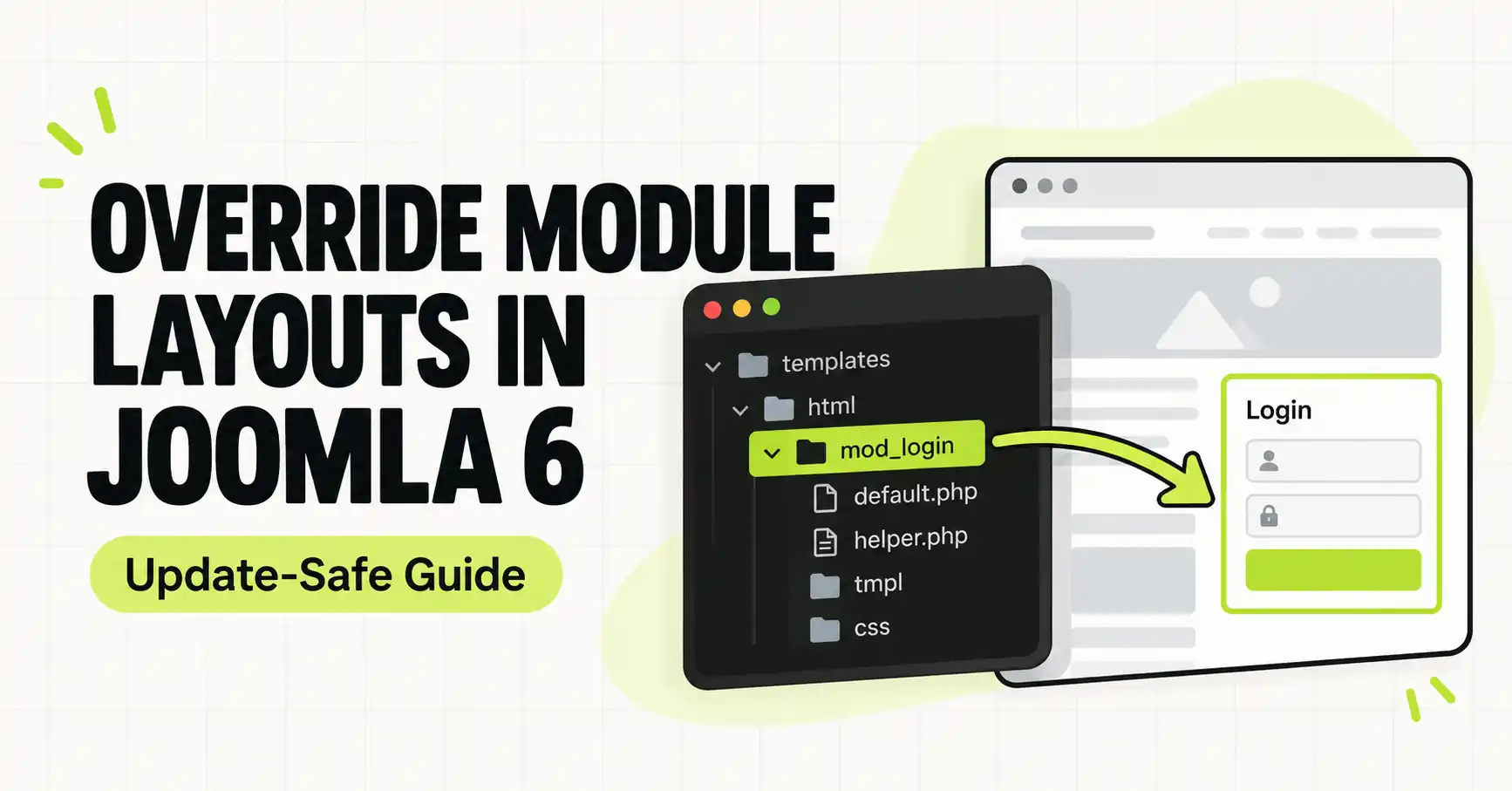
How to Override a Module Layout in Joomla 6 (Update-Safe Method)
Beginner
⏱ 5 min

Joomla Security Checklist: 12 Steps to Harden Your Site in 2026
Beginner
⏱ 11 min