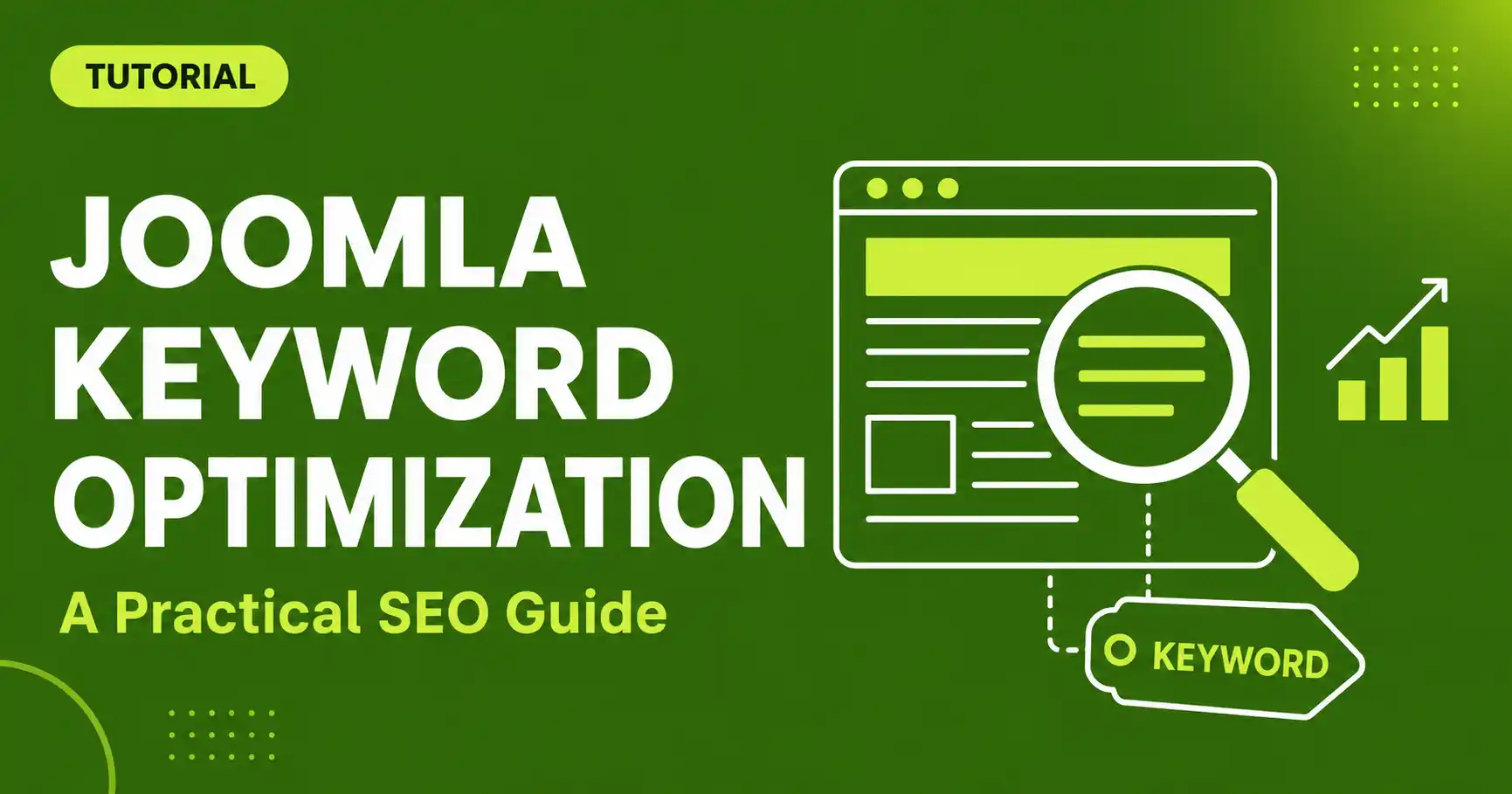
Tutorial
How to Optimize Keywords Naturally in Joomla Content
⚡ Quick Answer
Optimize keywords in Joomla by placing one primary keyword naturally in the title, H1, URL alias, first paragraph, and meta description — then supporting it with related terms in H2/H3 headings and image alt text. Skip the "Meta Keywords" field: Joomla's default configuration does not output it to the page, and Google has not used it as a ranking signal for years. Focus on natural language and topical coverage instead of keyword density targets.
🖼️
[IMAGE NEEDED — HERO]
Wide hero screenshot of the Joomla Article Manager list view, showing a few published articles with descriptive titles — sets the visual context for the tutorial.
Keyword optimization in Joomla is not about stuffing a target phrase into every sentence — it's about telling both readers and search engines what a page is actually about, using the fields Joomla already gives you. This guide walks through where keywords actually matter in a Joomla article, which fields are safe to skip, and how to avoid the mistakes that can get a page flagged under Google's spam policies. Steps apply to Joomla 5.4.x and 6.x (verified on Joomla 6.1.2, July 2026).
📋 What You'll Need
| Requirement | Notes |
|---|---|
| Joomla admin access | Author or higher, with access to Content → Articles |
| Joomla version | 5.4.x or 6.x (field names below match current versions) |
| A primary keyword | One target phrase per article, based on real search intent — not guessed |
| 2–3 related keywords | Supporting terms for headings and body copy, not synonyms stuffed in for volume |
Step 1: Research Keywords Based on Intent, Not Volume Alone
Before touching Joomla, define what a reader is actually trying to accomplish. Pull real queries from Google Search Console (Performance report), Google's autocomplete and "People also ask" boxes, or a keyword tool of your choice. Group them by intent — informational ("how to..."), comparison ("X vs Y"), or transactional ("buy," "download," "pricing") — and pick one primary keyword per article that matches the intent of that specific page.
💡 One keyword, one page
Trying to rank a single article for five unrelated keywords usually dilutes all of them. Assign one primary keyword and 2–3 closely related terms per article, and create separate articles for genuinely different search intents.
Step 2: Set the Title, H1, and URL Alias
In Content → Articles → New/Edit, the article Title field doubles as the front-end H1 in most Joomla templates. Include your primary keyword near the start of the title, phrased the way a person would actually read it — not as a keyword list.
Below the Title field, Joomla auto-generates an Alias, which becomes the URL slug when Search Engine Friendly URLs are enabled (Global Configuration → Site → SEO Settings). Edit the alias manually if needed so it stays short and matches the keyword in natural word order, for example joomla-keyword-optimization rather than a truncated or auto-generated string.
🖼️
[IMAGE NEEDED — STEP 2]
Screenshot of the Article edit screen, Title and Alias fields at the top, with the Alias field circled in red to show where the URL slug is edited.
Step 3: Use the Keyword Naturally in the First 100 Words
Search engines and AI answer engines both weight early content heavily when confirming what a page is about. Work the primary keyword — or a very close natural variation — into the first paragraph, without forcing an awkward sentence. If it doesn't fit naturally in the first two sentences, rewrite the opening rather than jamming the phrase in.
Step 4: Structure Headings Around Real Questions and Related Terms
Use H2/H3 headings that match how people actually search or ask questions, and spread related keywords across those headings instead of repeating the primary keyword in every one. For a tutorial, sequential headings like "Step 1," "Step 2" are fine; for review or explainer content, question-style or command-style headings ("How to check your Joomla version," "Fix duplicate meta descriptions") tend to match how people phrase queries in AI tools.
Step 5: Write the Meta Description — and Skip Meta Keywords
Open the Publishing tab of the article and fill in Meta Description with a concise, keyword-inclusive summary (roughly 140–160 characters) that reads like a sentence, not a keyword list. This is what appears under your title in search results and is what AI Mode and Google's snippet generation draw from.
⚠️ Leave "Keywords" (Meta Keywords) empty
The Keywords field still exists in the Publishing tab, but Joomla core does not render it into the page's <head> when set to the default "Use Global" value, and Google has publicly ignored the meta keywords tag as a ranking signal for years. Spend that time on the Meta Description instead — it's the field that actually shows up in search results.
🖼️
[IMAGE NEEDED — STEP 5]
Screenshot of the article's Publishing tab, with the Meta Description field filled in and circled in red; the empty Keywords field visible below it for contrast.
Step 6: Add Descriptive Alt Text to Every Image
In the article's Images and Links tab (or directly in the editor when inserting an image), fill in the Image Description/alt text field for every image with a specific, human-readable description — not the filename, and not a keyword stuffed in for the sake of it. Alt text is read by screen readers and by image search crawlers, and increasingly by AI Mode's image indexing.
🖼️
[IMAGE NEEDED — STEP 6]
Screenshot of the Images and Links tab in the article editor, with the Image Description (alt text) field filled in and circled in red.
Step 7: Link Related Articles With Tags, Not Keyword-Stuffed Anchors
Use Joomla's Tags field (Content tab of the article) to connect articles that cover the same or adjacent keywords — this powers the built-in Tagged Items list and related-content modules, which is one of the simplest ways to build topical internal linking in Joomla without manually hunting for anchor text opportunities. When you do link manually inside body text, use descriptive anchor text ("see our Joomla SEF URL guide") rather than repeating the exact-match keyword in every link, which is itself a pattern Google's spam policies call out.
🖼️
[IMAGE NEEDED — STEP 7]
Screenshot of the article Content tab with the Tags field open, showing 2–3 relevant tags selected.
Step 8: Verify the Output
After saving, view the published page's source (Ctrl+U / right-click → View Page Source) and confirm the title tag, meta description, and heading structure match what you set. Read the article back out loud — if a sentence sounds unnatural because of a repeated phrase, that's the sign to rewrite it before publishing, not after a ranking drop.
❓ FAQ
Does the Joomla "Meta Keywords" field still help SEO?
No. Joomla's default configuration doesn't output it to the page's <head>, and Google has not used the meta keywords tag as a ranking factor for years. It's safe to leave empty.
What keyword density should I aim for?
There's no safe target percentage to aim for. Write naturally and cover the topic thoroughly; unnatural repetition of a phrase is explicitly listed under Google's keyword stuffing spam policy, regardless of the exact density.
Where should my primary keyword appear first?
In the article title/H1, the URL alias, and the first paragraph — ideally the first two sentences — phrased the way a person would naturally write it.
Should my URL alias match the keyword exactly?
It should be close and readable, not padded. A short, natural slug like joomla-keyword-optimization works better than a long string of stacked keywords.
How many keywords should one Joomla article target?
One primary keyword plus 2–3 closely related terms per article. Targeting many unrelated keywords on a single page usually weakens rankings for all of them.
Does Joomla's Smart Search (com_finder) affect keyword ranking on Google?
Smart Search indexes content for your site's internal search box, not for Google. It doesn't directly influence external rankings, but a well-tagged, well-linked site structure that Smart Search relies on also helps crawlers understand topical relationships.
🧯 Common Mistakes to Avoid
- Filling in the Meta Keywords field and stopping there — it does nothing for Google; the Meta Description is the field that matters.
- Chasing a keyword density percentage — Google explicitly lists unnatural repetition of phrases as keyword stuffing, one of its named spam policies.
- Stuffing the URL alias with every keyword variation — long, padded slugs read as manipulative and hurt click-through rate in search results.
- Repeating the exact-match keyword in every internal link's anchor text — vary anchor text and prioritize descriptive, natural phrasing.
- Leaving image alt text blank or generic ("image1," "screenshot") — this is a missed, low-effort opportunity for both accessibility and image search visibility.
➡️ What's Next
Once your keyword structure is in place, review your meta titles and descriptions site-wide, and check your Joomla SEF URL and sitemap settings to make sure the pages you've optimized are actually crawlable and indexable.
✅ Last verified on Joomla 6.1.2 / 5.4.7 — July 2026

Thanh Le
Joomla Specialist & Technical Writer
Thanh Le is a Joomla expert and technical writer at Jlvextension.com, known for creating in-depth tutorials, extension reviews, and optimization guides. His work focuses on helping developers and webs