Tutorial
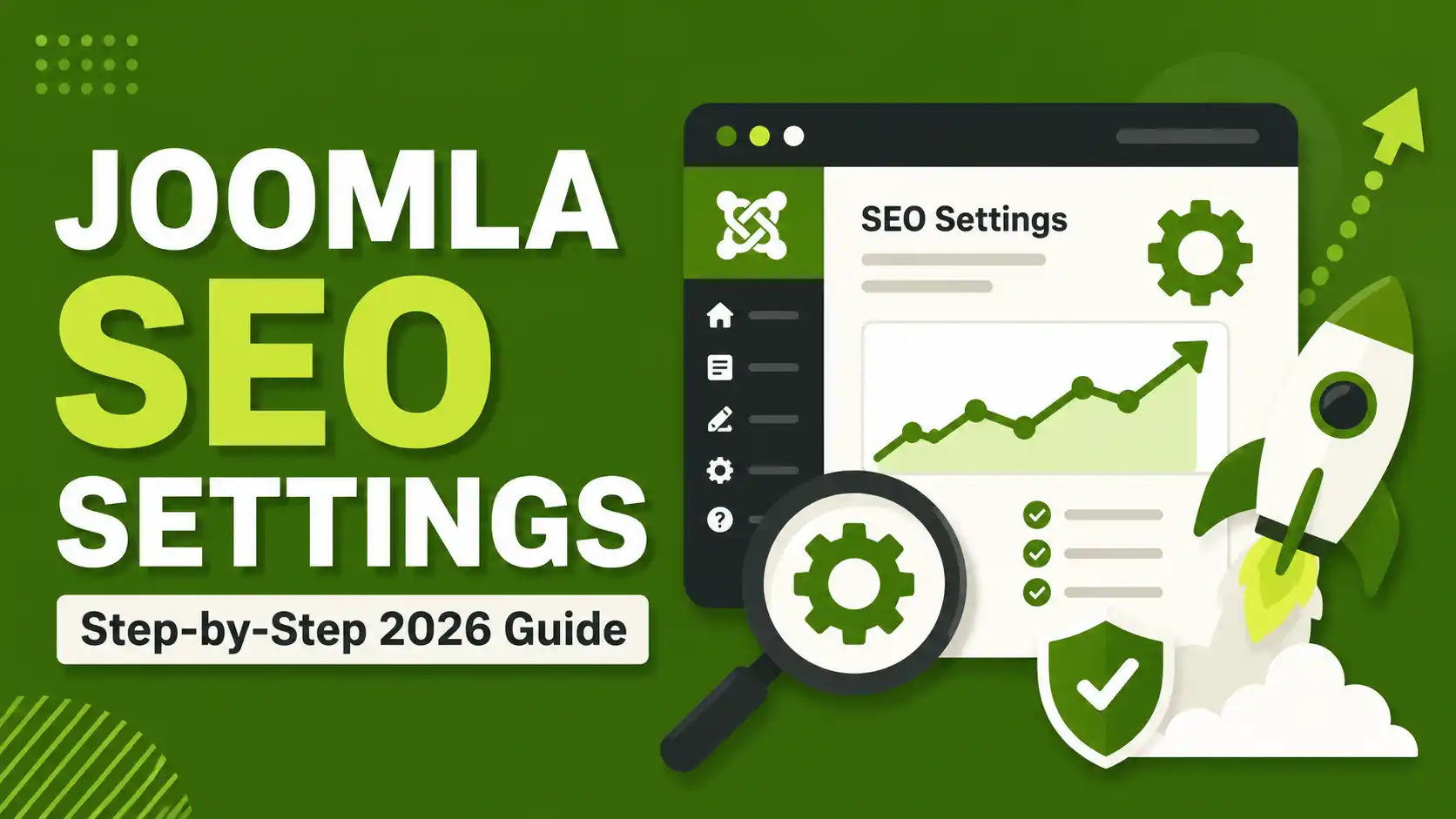
How to Configure Joomla SEO Settings for Better Rankings (2026 Guide)
⚡ Quick Answer
To configure Joomla SEO settings, turn on Search Engine Friendly URLs and URL rewriting, force HTTPS, set a global meta description with Robots set to Index, Follow, fix duplicate content with canonical URLs, install an XML sitemap extension (Joomla has no built-in sitemap), and submit that sitemap to Google Search Console.
| What you'll need | Details |
|---|---|
| Joomla access | Super User (Administrator) login |
| Joomla version | 5.4.x or 6.1.x (steps also apply to 4.x with minor menu differences) |
| Server access | File Manager or FTP, to rename htaccess.txt |
| Google Search Console | A verified property for your domain |
| Time required | 20–30 minutes |
Joomla ships with a working set of native SEO controls, but almost none of them are optimized out of the box. This guide walks through every setting worth changing in Global Configuration, in the order that actually matters, using Joomla 6.1 / 5.4 as the reference version. None of these steps require a premium extension — sitemap generation is the one exception, since Joomla does not include an XML sitemap generator natively.
Step 1: Turn On Search Engine Friendly URLs
Go to System → Global Configuration → Site tab → SEO Settings.
- Search Engine Friendly URLs: Yes
- Add Suffix to URL: No (recommended — adding
.htmlto every URL adds no ranking value and creates one more thing to keep consistent) - Unicode Aliases: leave at the default unless your content is primarily in a non-Latin script; if you switch this after URLs are already indexed, you will need 301 redirects for the old aliases
🖼️
[ẢNH CẦN CHỤP]
Joomla admin, System → Global Configuration → Site tab, SEO Settings panel with "Search Engine Friendly URLs" and "Add Suffix to URL" fields visible.
Step 2: Enable URL Rewriting
Search Engine Friendly URLs alone still leaves index.php in every URL. To get clean URLs, you also need URL rewriting:
- In the same SEO Settings panel, set Use URL Rewriting: Yes
- Rename the file
htaccess.txtin your Joomla root to.htaccessusing File Manager or FTP - Confirm with your host that
mod_rewriteand.htaccessoverrides are enabled on the server — most managed hosting enables this by default, but some hardened or containerized environments do not
⚠️ Common trap
If you enable "Use URL Rewriting" before renaming htaccess.txt, your entire site will throw a 500 error. Always rename the file first, then flip the setting, then test the homepage.
🖼️
[ẢNH CẦN CHỤP]
File Manager (cPanel or Joomla admin's own file manager) showing htaccess.txt in the Joomla root directory being renamed to .htaccess.
Step 3: Set Global Metadata and Robots
Go to System → Global Configuration → Site tab → Metadata Settings.
- Site Meta Description: write one — this is the fallback description used on any page (article, category, menu item) that doesn't have its own meta description set
- Site Meta Keywords: optional — Google has ignored the keywords meta tag for years, so don't spend time here
- Robots: Index, Follow — this is Joomla's default, but verify it after any migration or staging-to-live move, since staging sites are often deliberately set to noindex and that setting can survive a copy
Step 4: Force HTTPS
Go to System → Global Configuration → Server tab and set Force HTTPS to Entire Site. Save. This ensures every page redirects to the secure version, which removes duplicate HTTP/HTTPS versions of your pages from being crawled separately.
🖼️
[ẢNH CẦN CHỤP]
Joomla admin, System → Global Configuration → Server tab, with the "Force HTTPS" dropdown set to "Entire Site" circled in red.
Step 5: Configure Site Name in Page Titles
Still on the Site tab, find Site Name in Page Titles and set it to Before, After, or None. This controls whether your site name gets appended to every page's <title> tag. The direct SEO impact is small, but it affects branding in browser tabs and social previews, so pick a value and keep it consistent — don't leave it unset by accident.
Beyond this global setting, every individual article, category, and menu item should have its own meta title and meta description filled in under that item's Publishing tab. The site-wide fallback is a safety net, not a substitute for unique titles on your most important pages.
Step 6: Fix Duplicate Content With Canonical URLs
Joomla's menu system means the same article can often be reached from more than one URL (for example, an article that lives both in a "Blog" menu item and a "Featured" menu item). Search engines see these as separate pages with identical content, which dilutes ranking signals.
- Avoid creating multiple menu items that point to the same article unless necessary
- On each article's Publishing tab, check the Canonical URL field and point it to the single preferred URL when an article is reachable from more than one path
- For pages that have been permanently moved or restructured, set up 301 redirects rather than leaving old URLs to 404
📊
[ẢNH CẦN CHỤP]
Joomla article editor, Publishing tab, showing the Canonical URL field with an example URL entered.
Step 7: Add an XML Sitemap and Submit It to Google
ℹ️ Good to know
Joomla does not generate an XML sitemap natively — this is the one step in this guide that requires a third-party extension (for example OSMap, JSitemap, Aimy Sitemap, or JL Sitemap; all have free tiers and current Joomla 5/6 support).
- Install a sitemap extension from the Joomla Extensions Directory
- Configure it to include your menu structure, article categories, and any custom components you use
- Generate the sitemap and confirm
yourdomain.com/sitemap.xmlloads correctly - In Google Search Console, go to Sitemaps and submit the sitemap URL
📊
[ẢNH CẦN CHỤP]
Google Search Console, Sitemaps section, with the sitemap.xml URL entered in the "Add a new sitemap" field and a "Success" status shown for a previously submitted sitemap.
Step 8: Add Structured Data
Joomla's core does not generate JSON-LD structured data on its own. To add it, use either a custom head-code plugin/extension (many Joomla SEO extensions include one) or a "Custom Code" / "Insert code before </head>" field if your template provides one, and paste in Article, BreadcrumbList, and, where relevant, Review or FAQPage schema as a single <script type="application/ld+json"> block. See the accompanying schema file for ready-to-use markup for this exact article.
❓ Frequently Asked Questions
Does Joomla have SEO built in?
Yes, but only partially. Joomla includes SEF URLs, URL rewriting, global metadata, robots control, and canonical URL fields natively. It does not include an XML sitemap generator or JSON-LD structured data — both need an extension or custom code.
Do I need a paid SEO extension for Joomla?
Not necessarily. The native settings in this guide plus a free sitemap extension cover the technical basics. Paid extensions add convenience — bulk metadata editing, automated schema, redirect management — but aren't required to rank.
Why isn't my Joomla site showing up in Google?
Check three things first: Robots is set to Index, Follow in Global Configuration; the site isn't accidentally still set to noindex from a staging copy; and you've submitted a sitemap in Google Search Console. Indexing can also simply take days to weeks after launch.
Does adding a suffix to URLs help SEO?
No. Adding .html or similar suffixes to Joomla URLs has no measurable ranking benefit and is generally left off in current guidance, since shorter, cleaner URLs are easier for both users and crawlers to parse.
Is FAQ or HowTo schema still worth adding in 2026?
It won't produce a Google rich snippet — Google narrowed HowTo rich results in March 2026 and removed FAQ rich results in May 2026. It's still useful as clean, structured content that AI answer engines like Google AI Mode and Gemini can parse and cite, even without a search-result visual payoff.
Which Joomla version should I use for the best SEO setup?
Use the latest point release of a currently supported major version — as of this writing, that's Joomla 6.1.x or 5.4.x. Older unsupported versions miss security patches, and search engines factor site security and uptime into trust signals indirectly.
🧯 Common Mistakes to Avoid
Skip these and save yourself a rollback
Enabling "Use URL Rewriting" before renaming htaccess.txt (causes a 500 error).
Leaving "Add Suffix to URL" on out of habit from older Joomla tutorials.
Forgetting to flip Robots back to Index, Follow after moving a site from staging to production.
Creating duplicate menu items to the same article without setting a canonical URL.
Assuming Joomla auto-generates a sitemap — it does not, without an extension.
Writing a JSON-LD block by hand and forgetting to update dateModified when the page is later edited.
✅ Last verified on Joomla 6.1.2 / 5.4.7 — August 2026.

Thanh Le
Joomla Specialist & Technical Writer
Thanh Le is a Joomla expert and technical writer at Jlvextension.com, known for creating in-depth tutorials, extension reviews, and optimization guides. His work focuses on helping developers and webs