Tutorial
The Best SEO Tools Every Joomla Website Should Use
⚡ Quick Answer
The best Joomla SEO tools for 2026 cover four jobs: indexing & monitoring (Google Search Console), on-page/meta management (4SEO or RSSEO!), structured data (Joomla's native Schema.org plugin or Google Structured Data), and performance testing (Google PageSpeed Insights, GTmetrix). Most sites only need 3–4 of these running together, not every tool on this list at once.
Joomla ships with more SEO groundwork than people give it credit for — SEF URLs, meta fields on every article, and since Joomla 5, a native Schema.org system. But a default install still can't do keyword tracking, Core Web Vitals testing, or advanced structured data on its own. This list covers the tools — built-in and third-party, free and paid — that actually fill those gaps, organized by the job each one does. This post contains affiliate links; see our disclosure for details.
🖼️
[ẢNH CẦN CHỤP]
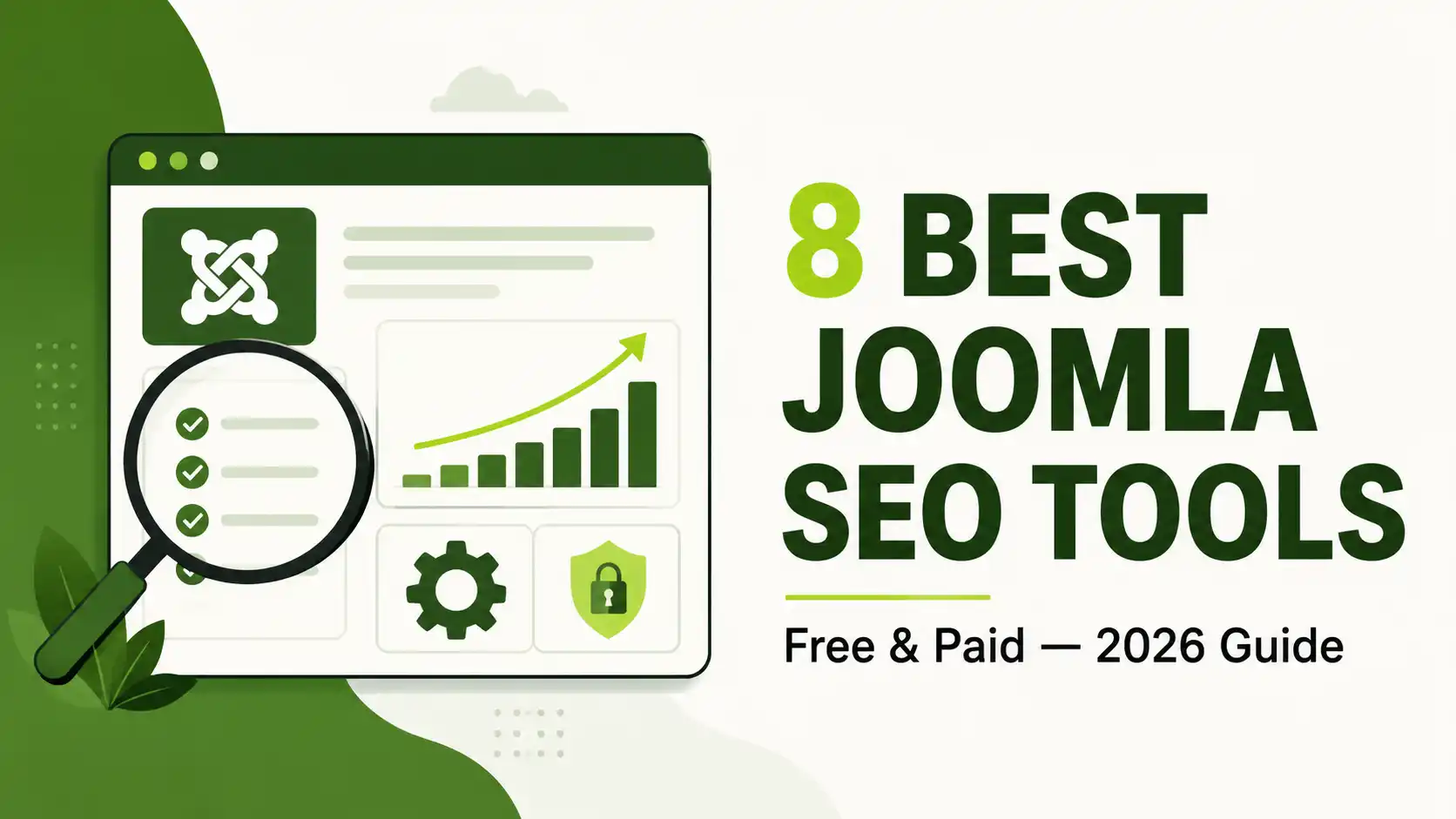
Hero image — a wide shot mockup or dashboard-style graphic showing "Joomla SEO tools" as a category, e.g. a collage of Search Console, GTmetrix, and a Joomla admin panel.
What You'll Need Before Choosing a Tool
| Requirement | Why it matters |
|---|---|
| Joomla 4 or 5 install | Some tools (native Schema.org plugin, 4SEF/4SEO) require Joomla 4+; sh404SEF-era extensions no longer apply. |
| Google Search Console verified | Needed before any structured data or performance fix can be measured against real indexing/ranking data. |
| Admin access to System → Plugins | Joomla's native Schema.org system plugin must be enabled manually — it's off by default. |
| A clear budget line (free vs. paid) | Several tools below have a capable free tier; only add a paid extension once the free tier's limit is actually hit. |
Quick Comparison: 8 Joomla SEO Tools at a Glance
| Tool | Category | Free/Paid | Best for |
|---|---|---|---|
| Google Search Console | Indexing & monitoring | Free | Every Joomla site, no exception |
| 4SEO | On-page / meta / sitemap | Free tier + paid | All-in-one SEO management |
| 4SEF | SEF URLs | Free tier + paid | Sites migrating off sh404SEF |
| RSSEO! | Keyword tracking & reporting | Paid | Agencies sending client reports |
| Joomla Schema.org plugin | Structured data | Free (built-in) | Basic Article/Author schema, no extension |
| Google Structured Data | Structured data | Free tier + Pro | Product, Event, FAQ, Review schema types |
| Screaming Frog SEO Spider | Site crawling & audit | Free tier + paid | Finding broken links, duplicate titles, redirect chains |
| PageSpeed Insights + GTmetrix | Performance | Free | Core Web Vitals and load-time diagnostics |
1. Google Search Console — Start Here Before Anything Else
1
Google Search Console
Search Console is Google's own free tool for tracking how a site is indexed and how it performs in search. For a Joomla site it's the first thing to set up, before touching any SEO extension — it's the only way to confirm whether structured data, sitemap changes, or Core Web Vitals fixes are actually being picked up by Google. It reports indexing status, search queries and clicks, mobile usability issues, and any structured data errors Google detects on crawled pages.
📊
[ẢNH CẦN CHỤP]
Screenshot of Google Search Console's Performance report or Coverage/Indexing report, showing a Joomla site's real query data (blur/redact any sensitive numbers if needed).
2. 4SEO — All-in-One On-Page SEO for Joomla
2
4SEO (by Weeblr)
4SEO is the successor to the long-running sh404SEF, which was discontinued on August 17, 2023 when Joomla 3 support ended. It's built as an all-in-one SEO extension: page-by-page meta data management (frontend or backend), automatic sitemap generation with image-sitemap support, structured data generation, Core Web Vitals measurement, and social sharing tags (OpenGraph/Twitter Cards). It also includes an import tool to bring over meta data and redirects from an old sh404SEF install.
🖼️
[ẢNH CẦN CHỤP]
Screenshot of the 4SEO admin interface — the page metadata editor screen showing title/description fields for a Joomla article.
3. 4SEF — Dedicated SEF URL Extension
3
4SEF (by Weeblr)
4SEF is the URL-only counterpart to 4SEO — also from Weeblr, and also built as a direct continuation of sh404SEF. It generates the same style of SEF URLs sh404SEF used to, runs on Joomla 3, 4, 5, and 6 without a compatibility layer, and is meant for sites that only need clean, non-duplicated URLs without the rest of 4SEO's on-page feature set. Sites already using 4SEO don't need this as a separate extension, since 4SEO covers URLs as well.
4. RSSEO! — Keyword Tracking and Client Reporting
4
RSSEO! (by RSJoomla)
RSSEO! leans more toward monitoring than on-page editing: keyword position tracking, competitor tracking, a built-in site crawler for finding broken pages, an automatic image ALT/title tag generator, and scheduled custom SEO reports that can be sent directly to clients. It's a better fit for agencies managing several Joomla sites than for a single-site DIY setup.
🖼️
[ẢNH CẦN CHỤP]
Screenshot of RSSEO!'s keyword position tracking dashboard or its scheduled-report configuration screen.
5. Joomla's Native Schema.org Plugin — Free, No Extension Needed
5
Joomla core Schema.org system (Joomla 5+)
Starting with Joomla 5, structured data moved from being purely a third-party feature to a built-in plugin-based system, added through a Google Summer of Code project. It works through a System — Schema.org plugin plus a set of individual schema-type plugins — enable them under System → Plugins, then fill in the Schema tab that appears in the article editor. Joomla 3 and 4 don't have this system; those versions still rely on manual JSON-LD or a third-party extension.
6. Google Structured Data (by Tassos Marinos) — Advanced Schema Types
6
Google Structured Data
For schema types beyond what Joomla's core plugins cover — Product, Event, FAQ, Job Posting, Review, Course — this is the most widely used third-party extension in the Joomla ecosystem, holding a 5-star rating on the Joomla Extensions Directory. The free version covers the Article type; the Pro version unlocks more than 15 schema types and integrates with K2, VirtueMart, HikaShop, and Zoo Content Builder. No coding is required for supported types, and it supports custom markup for anything outside the standard list.
🖼️
[ẢNH CẦN CHỤP]
Screenshot of the Google Structured Data extension's schema-type selector screen, showing the list of available markup types (Article, Product, FAQ, etc.).
7. Screaming Frog SEO Spider — Full-Site Technical Audit
7
Screaming Frog SEO Spider
Screaming Frog isn't Joomla-specific, but it's the standard desktop crawler most SEOs run against any CMS — Joomla included — to catch what dashboards inside the CMS can't: broken internal links, duplicate title tags and meta descriptions, redirect chains, missing ALT text at scale, and orphaned pages. The free tier crawls up to 500 URLs per crawl, enough for most small-to-mid Joomla sites; larger sites need the paid license.
8. Google PageSpeed Insights + GTmetrix — Performance and Core Web Vitals
8
PageSpeed Insights & GTmetrix
These two are usually run together rather than one instead of the other. PageSpeed Insights is Google's own tool, pulling from the same Chrome UX Report (CrUX) real-user data Google uses for ranking signals, plus a Lighthouse lab test. GTmetrix layers on a Lighthouse-based Performance/Structure grade (A–F), a request waterfall chart for pinpointing exactly which asset is slow, and historical tracking across repeated tests — useful for confirming a fix actually helped after a template or hosting change.
📊
[ẢNH CẦN CHỤP]
Side-by-side screenshot: PageSpeed Insights score screen next to GTmetrix's waterfall chart, both run against the same Joomla page.
💬 A note on tool overload
Running all eight tools on one site at once is overkill. A lean stack for most Joomla sites is: Search Console (always) + 4SEO (on-page/schema/sitemap in one) + PageSpeed Insights or GTmetrix (performance) + Screaming Frog for a quarterly technical audit. Add RSSEO! or Google Structured Data only when a specific gap — client reporting, or a schema type 4SEO doesn't generate — actually shows up.
❓ Frequently Asked Questions
Does Joomla have built-in SEO tools?
Yes. Every Joomla site has SEF URL settings and per-article meta fields out of the box, and Joomla 5 added a native Schema.org structured data system via System — Schema.org and related plugins — no extension required for basic Article schema.
Is sh404SEF still available for Joomla?
No. sh404SEF was discontinued on August 17, 2023, alongside Joomla 3's end of support. Its developer, Weeblr, now maintains 4SEF (URLs) and 4SEO (all-in-one SEO) as the direct successors, both running on Joomla 3, 4, 5, and 6.
Which tool should I use for structured data on Joomla 4?
Joomla 4 doesn't have the native Schema.org plugin system introduced in Joomla 5, so a third-party option — Google Structured Data by Tassos Marinos, or the structured data built into 4SEO — is the practical choice until upgrading.
What's the difference between GTmetrix and PageSpeed Insights?
PageSpeed Insights is Google's own tool and reports real-user Core Web Vitals from the Chrome UX Report alongside a Lighthouse lab test. GTmetrix runs its own Lighthouse-based test plus a request waterfall chart and lets you track scores over time — most people use both, not either/or.
Do I need a paid extension to do Joomla SEO properly?
Not necessarily. Google Search Console, PageSpeed Insights, GTmetrix, and Joomla's native Schema.org plugin are all free and cover indexing, performance, and basic structured data. Paid extensions like 4SEO Pro or RSSEO! add automation and reporting on top of that free foundation.
Can I run Screaming Frog against a Joomla site the same way as WordPress?
Yes — Screaming Frog crawls any CMS the same way, since it works against the rendered HTML/URLs rather than the platform itself. The free tier's 500-URL limit is the main thing to watch on larger Joomla sites.
➡️ What's Next
Once indexing and on-page basics are in place, the next practical step is usually structured data — see our guide on how to add Schema Markup in Joomla for the plugin-by-plugin setup.
✅ Last verified on Joomla 5 — July 2026

Thanh Le
Joomla Specialist & Technical Writer
Thanh Le is a Joomla expert and technical writer at Jlvextension.com, known for creating in-depth tutorials, extension reviews, and optimization guides. His work focuses on helping developers and webs