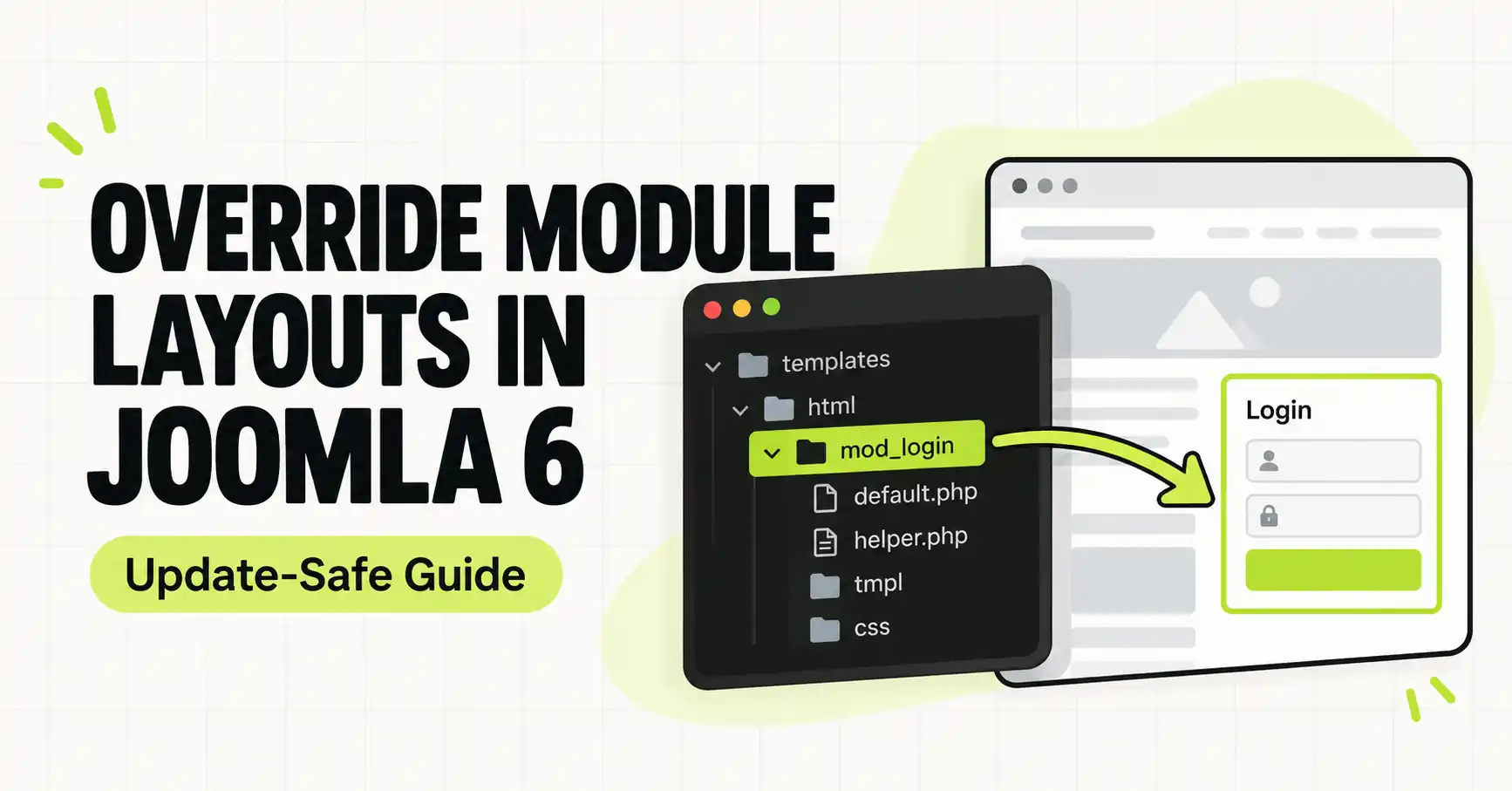
How to Override a Module Layout in Joomla 6 (Update-Safe Method)
Beginner
⏱ 5 min
⚡ Quick Answer
In Joomla 6, go to Extensions → Modules → New, pick a content-display module type (Articles - Category Blog, Custom HTML, Menu, etc.), set its Position and Menu Assignment, then publish. The module renders anywhere that position is defined in your active template — sidebar, header, footer, or inline inside an article via {loadposition}.
| What you'll need | Details |
|---|---|
| Joomla version | 6.0.0 or later (this guide covers 6.0–6.1) |
| Server | PHP 8.3.0+ (Joomla 6's minimum requirement) |
| Access level | Super User or Manager, with access to Extensions and Content |
| Template used in examples | Cassiopeia (Joomla's default template) |
| Content ready | At least one published category and article, if you plan to display articles via a module |
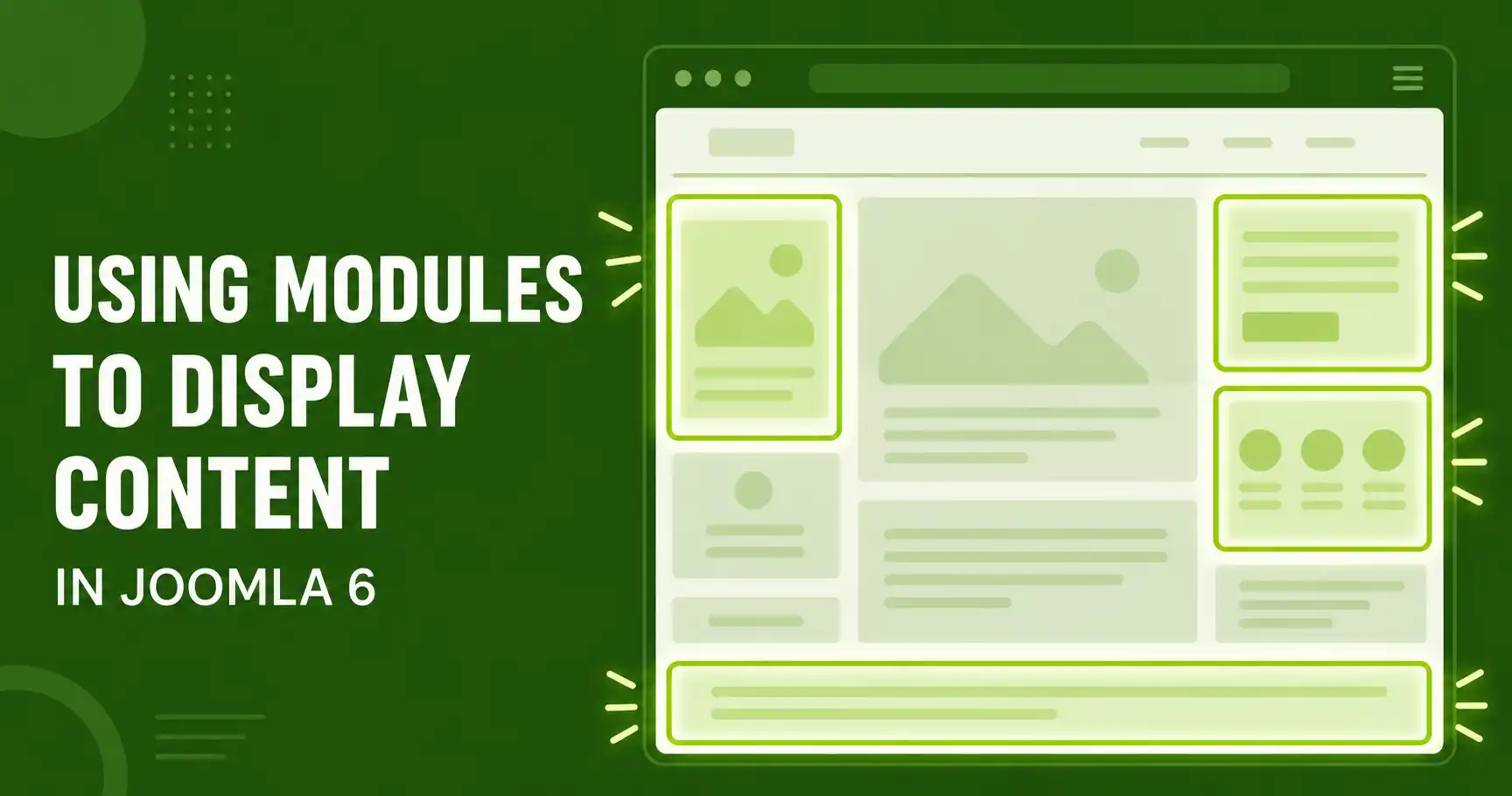
Modules are how you put content around your articles — a category feed in the sidebar, a menu across the top, a related-articles block under a post. This guide walks through the Module Manager in Joomla 6, the module types built for displaying content, and how to get a module to actually show up where you expect it. Steps and screen paths below match the standard Joomla 6 administrator, using Cassiopeia's position names as the working example.
Before touching the backend, it helps to separate three things Joomla users often blur together:
Why this matters
A module set to a position your template doesn't define will never appear on the frontend — Joomla won't show an error, it will just silently not render. This is the single most common reason a "correctly configured" module seems broken.
Go to Content → Site Modules (or Extensions → Modules, depending on your admin menu layout) and click New in the top-right corner. Joomla opens a list of available module types — this list includes both core modules and any installed from third-party extensions.
Joomla 6 ships with several core module types built specifically to surface article content without any custom coding. The most relevant ones for content display:
| Module type | What it displays |
|---|---|
| Articles - Category Blog | Multiple articles from one or more categories, blog-style with intro text and images |
| Articles - Category List | A titles-only list of articles from a category — good for compact sidebars |
| Articles - Newsflash | A rotating or stacked snippet of recent articles, often used above the fold |
| Articles - Related Articles | Articles sharing tags/category with the one currently being viewed |
| Articles - Most Read | Ranked list based on the article hit counter |
| Articles - Archived | A list of archived articles, grouped by month |
| Custom (Custom HTML) | Free-form HTML/text you write yourself — banners, CTAs, embedded widgets |
| Menu | A navigation menu you've built under Content → Site Menus |
| Breadcrumbs | The auto-generated path (Home > Category > Article) for the current page |
Select the type that matches your goal — for example, Articles - Category Blog to turn a category into a mini blog feed in a sidebar or homepage block.
After choosing a type, give the module a clear internal Title (this is what shows above the content on the frontend, unless you hide it — see below). Then work through the module-specific tabs:
⚠️ Common mix-up
Don't confuse a Custom Fields display (which lives inside an article's own layout) with a module. Custom Fields render as part of the article itself; modules render in a separate template position, independent of any single article.
Still in the Module tab, click Select Position to open the position picker, or type a position name directly if you already know it. If you're using Cassiopeia, the commonly used content-display positions are:
| Position | Typical use |
|---|---|
| sidebar-left / sidebar-right | Vertical stack next to the main content — menus, category lists, related articles |
| top-a / top-b | Cards above the main content, full page width |
| bottom-a / bottom-b | Cards below the main content — related articles, CTAs |
| main-top / main-bottom | Directly above or below the component output, inside the main column |
| banner | Full-width strip below the header, above the top cards |
| footer | Site-wide footer content |
Not sure which positions your active template offers, or where they physically sit on the page? Go to System → Templates → Site Templates, open your template's Options, and enable Preview Module Positions. Reloading the frontend then overlays labeled outlines on every available position.
Switch to the Menu Assignment tab. This controls which pages the module appears on, independent of its position:
⚠️ This is where most "invisible module" tickets come from
A module can be Published, in the right Position, and still not appear — because Menu Assignment excludes the page you're viewing. Always double-check this tab before assuming the module itself is broken.
You can publish as many modules as you like into one position — they stack in the order shown in the Module Manager. To reorder:
The backend order is exactly the frontend display order for that position.
Set Status to Published, confirm the Access level matches who should see it (Public, unless it's meant for logged-in users only), and click Save & Close. Reload the relevant frontend page — using a private/incognito window avoids any admin-session caching confusion — and confirm the content appears where expected.
{loadposition xy} or {loadmodule mod_name,Title} tag in the article — a template Position alone won't do this.A component controls the main content area of a page — like the article or category view. A module is a smaller content block placed around it, in a sidebar, header, or footer. Menus, search boxes, and custom HTML blocks are all modules.
Yes. Enable the Content - Load Module plugin, then add {loadposition xy} or {loadmodule mod_name,Title} directly in the article text. This places the module inline, independent of any template position.
As many as you want. Joomla stacks them in the order set by the Ordering column in the Module Manager, filtered to that position.
Check three things: Status is Published, Menu Assignment includes the current page, and the Position actually exists in the active template. Any one being wrong hides the module without an error message.
Yes. Positions are defined by the template, not the module. Switching templates usually breaks existing assignments, so modules need to be reassigned to the new template's position names.
No — module versioning shipped in Joomla 6.1 (April 2026), not 6.0. It's off by default; enable "Save History" under Content → Modules → Options if you're on 6.1+ and want it.
✅ Last verified on Joomla 6.1 — August 2026

Thanh Le is a Joomla expert and technical writer at Jlvextension.com, known for creating in-depth tutorials, extension reviews, and optimization guides. His work focuses on helping developers and webs