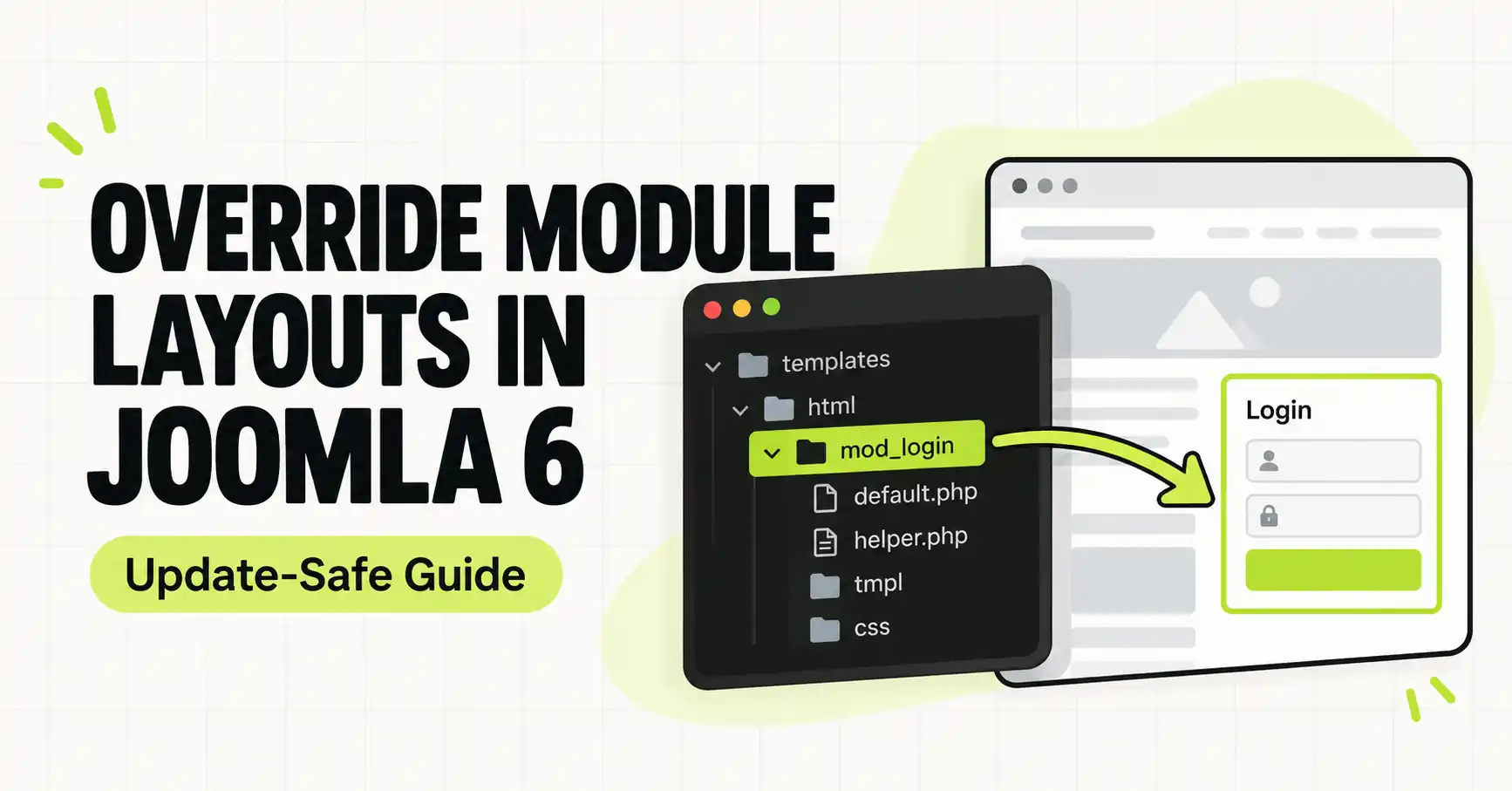
How to Override a Module Layout in Joomla 6 (Update-Safe Method)
Beginner
⏱ 5 min
Affiliate disclosure: This article contains affiliate links (including Envato/MonsterONE). If you purchase through them, we may earn a commission at no extra cost to you. We only recommend tools we'd use ourselves.
⚡ Quick Answer
Joomla has no built-in firewall. Real protection comes from stacking three layers: a network-level WAF (Cloudflare or Sucuri) in front of your server, an application-level WAF extension inside Joomla (Admin Tools Professional or RSFirewall), and scheduled malware/file-integrity scanning. Add backend hardening (2FA, IP allow-listing, backend password) and automated backups, and most automated attacks and malware infections are blocked before they ever touch your site.
| 📋 What you'll need | Details |
|---|---|
| Joomla version | 5.4.x (LTS) or 6.1.x — this guide is written against Joomla 6.1.2 / 5.4.7 |
| Access level | Super User (admin) account |
| Server access | FTP/SFTP or hosting File Manager (to edit .htaccess and recover if you get locked out) |
| An extension | Admin Tools (free Core or paid Professional) or RSFirewall — pick one as your primary application WAF |
| Backup | A full site + database backup taken before you start (Akeeba Backup or similar) |
| Time needed | 30–45 minutes for initial setup |
This guide covers how to set up firewall and malware protection for a Joomla site step by step: choosing the right combination of network and application firewalls, configuring the most important rules without locking yourself out, setting up automated malware scanning, and hardening backend access. It applies to Joomla 5.4 LTS and Joomla 6.1.x installations.
A web application firewall (WAF) filters HTTP traffic between visitors and your site, blocking requests that look like SQL injection, cross-site scripting (XSS), local/remote file inclusion (LFI/RFI), or brute-force login attempts — before Joomla ever processes them. Joomla's core is actively maintained and reasonably secure by default, but most real-world compromises come from outdated third-party extensions/templates, weak admin credentials, or misconfigured file permissions — none of which the core CMS can fix on its own. A firewall reduces exposure while you keep everything patched.
Two firewall layers, not one
Network/CDN WAF (Cloudflare, Sucuri) sits in front of your server and blocks traffic before it reaches your hosting — great for DDoS and mass bot traffic. Application WAF (Admin Tools, RSFirewall) runs inside Joomla and understands Joomla-specific requests, so it can catch things a generic network WAF misses, like malicious file uploads through a Joomla form.
Before installing anything, decide which layers you actually need based on your site's risk level:
| Layer | Examples | Best for |
|---|---|---|
| Network/CDN WAF | Cloudflare, Sucuri WAF, hosting-level ModSecurity | DDoS mitigation, blocking traffic before it hits your server, low-effort setup |
| Application WAF (Joomla extension) | Admin Tools, RSFirewall, SecurityCheck Pro | Joomla-aware rules, admin hardening, upload scanning, brute-force blocking |
| Malware/file-integrity scanner | Admin Tools Pro scanner, RSFirewall malware database, third-party antivirus scanners | Detecting files already on your server that shouldn't be there |
For a personal blog or low-traffic site, an application WAF extension plus scheduled scanning is often enough. For a high-value site (client work, e-commerce, high-traffic content), pair a network-level WAF with a paid application firewall.
The two most established options in the Joomla ecosystem are Admin Tools (by Akeeba) and RSFirewall (by RSJoomla). Both are actively maintained and compatible with Joomla 6.x at the time of writing.
| Extension | WAF included? | Malware/file scanning | 2FA | License |
|---|---|---|---|---|
| Admin Tools Core (free) | No — Core handles hardening only (permissions, backend password, database maintenance) | Basic file-change alerts | Via Joomla core 2FA | Free, GPL |
| Admin Tools Professional | Yes — full configurable WAF (SQLi, XSS, RFI/LFI, malicious user agents, CSRF, upload scanner) | Core file integrity scan | Yes | Paid — [CẦN BẠN XÁC NHẬN: giá hiện tại trên akeeba.com] |
| RSFirewall | Yes — SQLi, PHP, LFI, XSS, malware pattern blocking, upload filtering | Malware database scan of existing files | Yes | Paid — [CẦN BẠN XÁC NHẬN: giá hiện tại trên rsjoomla.com] |
| SecurityCheck Pro | Basic network firewall features | Vulnerability check for outdated components/plugins | No (as of last check) | Paid — [CẦN BẠN XÁC NHậN: giá hiện tại] |
Important: free ≠ full WAF
Admin Tools Core (free) does not include the Web Application Firewall — only the paid Professional edition does. If you install the free version expecting WAF protection, you're only getting hardening and maintenance tools, not active request filtering.
This example uses Admin Tools, but the same general order applies to RSFirewall.
Do this before enabling admin IP restrictions
Before turning on "Allow administrator access only to IPs in the Exclusive Allow IP List," add your current IP address to that list first, then save. Enabling this with the wrong IP — or a dynamic IP that changes — will lock you out of your own backend.
Rather than enabling every rule at once, turn on protections in this order and test your site after each group:
| Setting | Where | Why it matters |
|---|---|---|
| Backend password (secret URL parameter) | Admin Tools → Secret Backend URL | Hides the login page from automated scanners hitting /administrator directly |
| Two-factor authentication | Joomla core: Users → Manage → your user → Two-Factor Authentication tab | Stops account takeover even if a password is leaked |
| Brute-force lockout | Admin Tools/RSFirewall → Basic Features | Auto-blocks IPs after repeated failed logins |
Rename/restrict /administrator | Admin Tools → Configure WAF → Miscellaneous | Reduces automated brute-force noise |
A firewall blocks new attacks; a scanner catches what's already on your server. Set up a recurring scan (weekly at minimum) using one of:
Configure the extension to email you immediately if it finds a modified core file or a flagged pattern — don't rely on manually checking a dashboard.
🧯 Common Mistakes to Avoid
Enabling every WAF rule at once — this is the most common cause of "my site broke" support tickets; go rule-group by rule-group instead.
Turning on Exclusive Allow IP List without whitelisting your own IP first — instant admin lockout.
Assuming the free tier equals full protection — Admin Tools Core has no WAF; RSFirewall's free trial period is limited.
Skipping a backup before hardening .htaccess — a bad rule can 500-error your entire site with no easy rollback.
Relying on the firewall instead of updates — a WAF reduces risk, it does not patch the vulnerable code itself.
Never checking the log — a firewall silently blocking hundreds of attacks a day is useful signal you're otherwise throwing away.
No. Joomla's core includes basic security hygiene (input filtering, session handling, core file checksums via the built-in checker) but no active Web Application Firewall. You need an extension like Admin Tools Professional or RSFirewall, or a network-level WAF such as Cloudflare or Sucuri.
Both cover similar ground — SQLi/XSS/RFI blocking, brute-force protection, malware scanning. Admin Tools is often chosen for its deep backend-hardening toolkit; RSFirewall is known for its malware pattern database. Test the free/Core tier of each against your specific site before buying.
No. A WAF blocks incoming attacks, but it can't remove malware that's already on your server from a past compromise or an outdated extension. Pair it with a file-integrity/malware scanner and keep everything updated.
At minimum weekly, and immediately after installing any new extension or template. High-traffic or e-commerce sites should scan daily if the extension supports scheduling.
It can, if you enable every rule at once. Enable rule groups gradually and test forms, checkout, and uploads after each group, as outlined in Step 4 above.
For high-value sites, yes — the CDN/network WAF (Cloudflare, Sucuri) blocks traffic before it reaches your server, while the Joomla extension understands application-specific context the network layer can't see. For smaller sites, the Joomla extension alone is often sufficient.
✅ Last verified on Joomla 6.1.2 / 5.4.7 — July 2026

Thanh Le is a Joomla expert and technical writer at Jlvextension.com, known for creating in-depth tutorials, extension reviews, and optimization guides. His work focuses on helping developers and webs