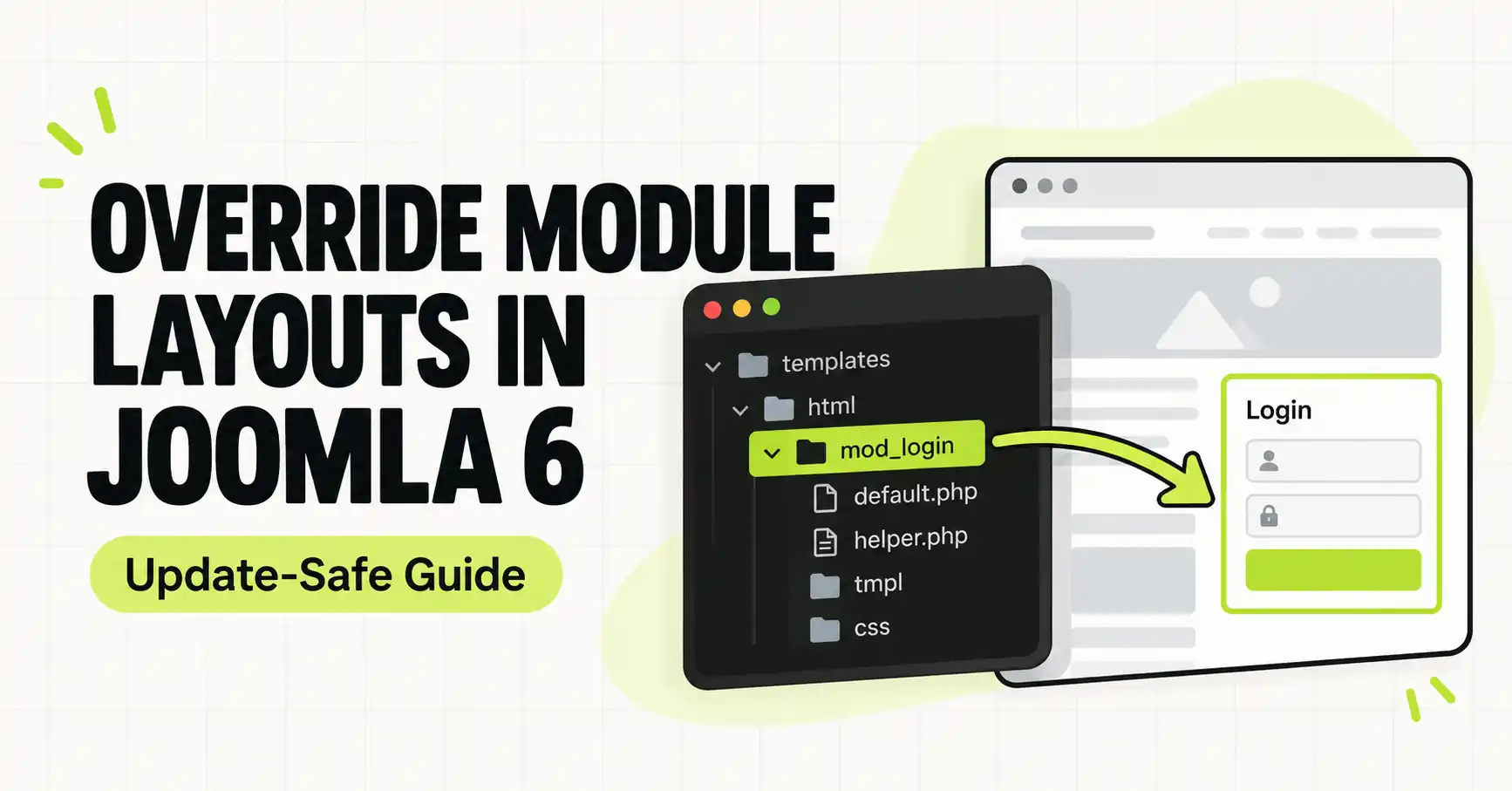
How to Override a Module Layout in Joomla 6 (Update-Safe Method)
Beginner
⏱ 5 min
⚡ Quick Answer
Joomla never hardcodes text. Every label, button, and message is a language constant (e.g. COM_CONTENT_READ_MORE) that gets resolved from .ini language files at runtime. When the same key exists in more than one file — core, extension, template, or override — Joomla applies a strict priority order, with language overrides winning every time. If a translation is missing for the active language, Joomla silently falls back to en-GB so the site never shows a broken string.
If you've ever opened a Joomla site and seen a stray English word in an otherwise translated page, or wondered why editing one language file didn't change the text you expected, the answer is almost always this loading-and-priority system. This guide breaks down how it works internally — language constants, file loading order, the override system, and the built-in tool Joomla gives you to debug it — based on Joomla 5.x behavior.
Instead of writing visible text directly into templates or PHP code, Joomla developers define every string as a language constant: an uppercase key mapped to a translatable value inside a language file.
COM_CONTENT_READ_MORE="Read more"At render time, Joomla looks up the constant in the currently loaded language files and swaps it for the translated value. This is why translating a Joomla site is mostly a matter of editing .ini files rather than touching template or component code.
Joomla doesn't load one giant language file. It loads many small .ini files depending on what's being rendered on the current page, pulled from several sources:
Each extension typically ships two separate sets of language files — one for the public site, one for the admin area:
| Context | Typical path |
|---|---|
| Frontend | /language/en-GB/ |
| Backend (Administrator) | /administrator/language/en-GB/ |
When the same constant is defined in more than one file, Joomla doesn't load them all as equals. It resolves conflicts using a fixed priority order, from lowest to highest:
Why this matters
If you change a string but it still shows the old text, check whether an override exists for that exact key — overrides always win, even over an edited core or extension file.
If the active language doesn't have a value for a given key, Joomla automatically falls back to en-GB rather than displaying a blank space or breaking the layout. This is why partially-translated language packs still produce a usable site — gaps are filled with English rather than left empty.
The frontend and the administrator area can run in different languages at the same time, each loading its own set of language files based on the site's Language Filter settings (frontend) and the individual user's language preference (backend). A visitor browsing in French and an admin working in English can use the same Joomla installation simultaneously without conflict.
When Joomla's native multilingual mode is enabled, individual pieces of content are explicitly tagged with a language:
The Language Filter system plugin then handles the visitor-facing side of this: detecting or switching the active language, redirecting to the right language version of a page, and building multilingual URLs.
Joomla ships a built-in diagnostic tool for figuring out exactly which constant produced a given piece of text — without searching through files manually.
Enable it at: System → Global Configuration → System tab → Debug Settings → Debug Language, then save.
Once active, every translated string on the page is wrapped in markers so you can tell at a glance whether it resolved correctly:
**KEY** — the string was found and translated successfully??KEY?? — the key has no translation and is missing from the loaded language filesThis makes it possible to identify the exact constant behind any piece of text on the page, and confirm whether an override has taken effect, without digging through the filesystem.
⚠️ Turn it off when you're done
Debug Language is a diagnostic tool, not a setting to leave on permanently — the marker characters are visible to anyone viewing the page. Switch it back to No once you've found the key you needed.
That happens when Debug Language mode is enabled and a key has no matching translation in the loaded language files. The ??KEY?? markers show you the exact constant that's missing so you can add it to an override or language file.
en-GB is Joomla's default source language. Every other language pack is translated against it, so whenever a key is missing from your active language, Joomla uses the en-GB value instead of leaving the text blank.
A higher-priority file is likely still defining that key. Language overrides always take precedence over core, extension, and template language files — check System → Language Overrides first.
No. Each extension ships separate file sets for /language/ (frontend) and /administrator/language/ (backend), so the public site and the admin panel can run in different languages independently.
No. Even a single-language Joomla site relies on this same constant-and-INI-file mechanism to render every button, label, and message — multilingual mode just adds language tagging on top of it for content items.
Enable Debug Language under System → Global Configuration → System tab. Every string on the page will be wrapped in markers showing its exact constant, so you don't have to search the filesystem manually.
🧯 Common Mistake to Avoid
Editing a core or extension language file directly to fix a translation. The next extension update will overwrite that file and silently undo your change. Use System → Language Overrides instead — overrides sit outside the extension and survive updates.
➡️ What's next: if you're setting up a multilingual Joomla site rather than just translating UI strings, the Language Filter plugin configuration and content language tagging are the next things to get right.
✅ Last verified on Joomla 5.x — June 2026

Stephen is the CEO and Founder of Jlvextension, known for creating high-quality Joomla templates and leading the development of innovative web solutions.