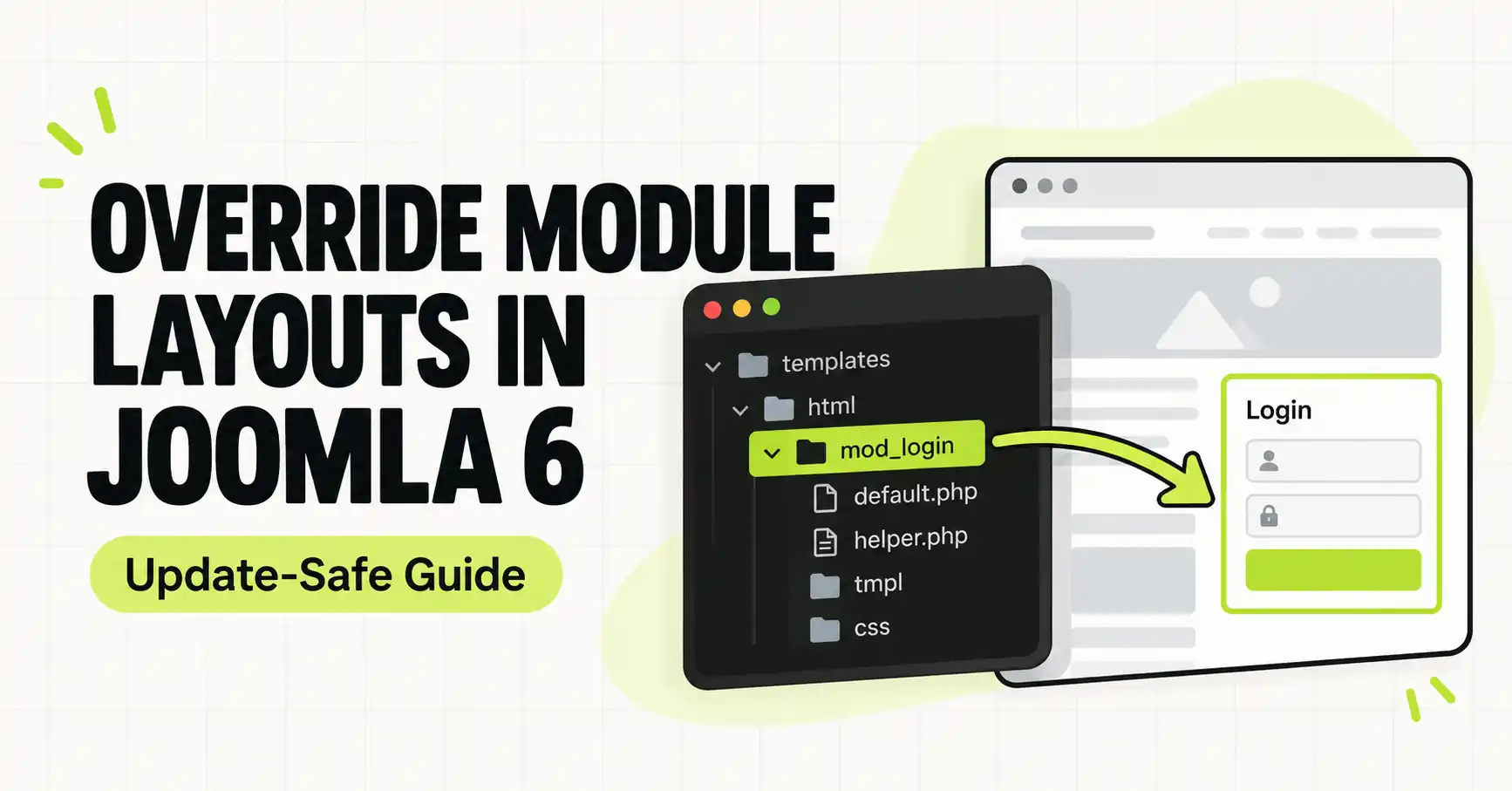
How to Override a Module Layout in Joomla 6 (Update-Safe Method)
Beginner
⏱ 5 min
Quick Answer
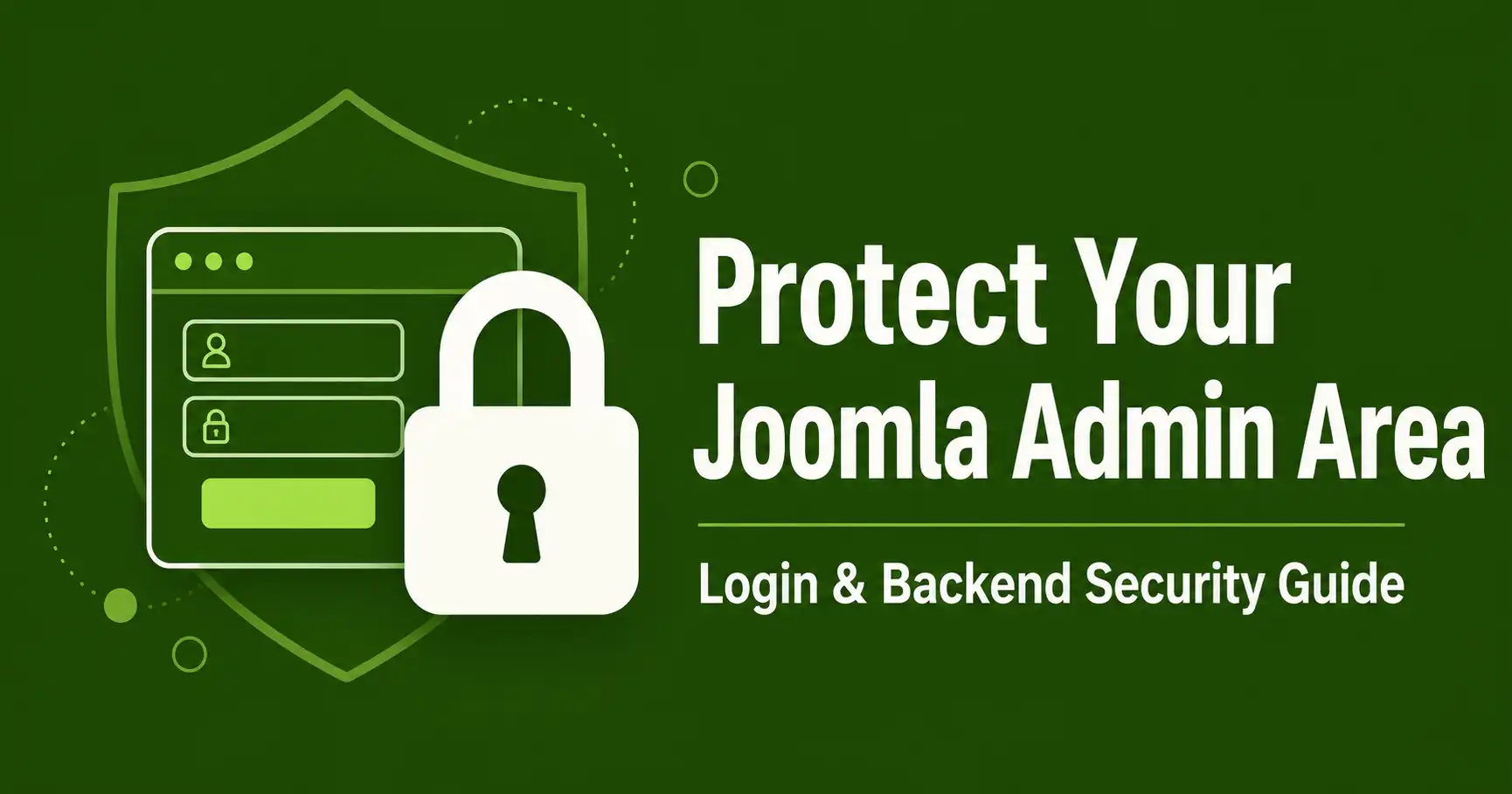
To protect your Joomla admin area, combine at least three layers: enable Joomla's built-in Two-Factor Authentication for every Super User, restrict or rename the /administrator URL, and enforce HTTPS with a strong, unique password. No single step is enough on its own — brute-force bots target the default login path 24/7, so layering access restriction with authentication is what actually stops them.
| What you'll need | Notes |
|---|---|
| Joomla 4.x, 5.x, or 6.x | Steps below apply to all three; Joomla 4 reached End of Life in October 2025, so upgrade first if you're still on it |
| FTP/SFTP or File Manager access | Needed to edit .htaccess inside /administrator |
| Hosting control panel (cPanel/Plesk) access | Optional, only needed for server-side "Directory Privacy" password protection |
| A static or semi-static IP address | Optional, only needed if you plan to restrict backend access by IP |
| Super User login | Required to enable Two-Factor Authentication and change Global Configuration settings |
Every Joomla installation exposes its login form at the same predictable path: yourdomain.com/administrator. That predictability is exactly what automated bots exploit — they don't need to find your site first, they just try /administrator on every domain they scan. This guide walks through the practical steps that actually reduce that risk, from free built-in Joomla settings to optional extensions, ordered roughly from "do this first" to "nice-to-have hardening."
⚠️ Affiliate Disclosure
This article contains affiliate links to Envato and MonsterONE. If you purchase through these links, we may earn a commission at no extra cost to you. We only recommend tools we believe genuinely help secure a Joomla site. [CONFIRM NEEDED: replace with your site's actual disclosure wording if different]
If any user account on your site is still named admin, change it now. This single change stops every bot that blindly tries the username admin with a list of common passwords — which is still the most common automated attack pattern against Joomla backends.
Joomla has shipped native Two-Factor Authentication since version 3.2, so you don't need a third-party extension to use it. With 2FA enabled, a stolen or guessed password alone is no longer enough to log in.
⚠️ Common Mistake
Enabling 2FA only on your own account and forgetting other Super Users (or shared/agency accounts) leaves an open door. Audit every account with backend access, not just yours.
If you or your team always access the backend from the same fixed IP address (home office, VPN, or company network), you can block every other IP from even reaching the login form. Edit the .htaccess file inside your /administrator folder:
<Files index.php>
Order Deny,Allow
Deny from all
Allow from 123.123.123.123
</Files>
Replace 123.123.123.123 with your actual IP address. You can add multiple Allow from lines if several people need access from different fixed IPs. If you're on Apache 2.4+, the equivalent syntax uses Require instead of Order/Allow — check with your host which version applies.
💡 Note
This only works well with a static or rarely-changing IP. If your IP changes frequently (common with residential ISPs or mobile connections), this step will lock you out of your own site — skip it or use a VPN with a fixed exit IP instead.
Keeping the default /administrator path means every scanner on the internet already knows exactly where your login form is. You have two practical options:
/administrator itself shows a 404 or is fully blocked to anyone without the secret URL/query parameter.Most cPanel and Plesk hosting accounts let you password-protect a folder at the web server level, before Joomla even loads. This adds an authentication prompt in front of your login page.
/administrator folder.After this, anyone visiting your admin URL sees a browser authentication prompt first — Joomla's own login page never even loads for unauthorized visitors.
Manual steps cover the basics, but a dedicated security extension adds ongoing, automated protection — blocking repeated failed login attempts, scanning for file changes, and applying a web application firewall (WAF) against common attack patterns.
[CONFIRM NEEDED: if you want a specific MonsterONE or Envato affiliate link inserted for a named security extension, provide the link and we'll add a price/CTA box here.]
Logging in over an unencrypted connection means your username and password travel in plain text — trivially interceptable on public Wi-Fi. Since free SSL certificates (e.g., via your host or Let's Encrypt) are standard with virtually every hosting plan today, there's no reason to skip this.
| Item | Recommended permission |
|---|---|
| Folders | 755 |
| Files | 644 |
configuration.php | 444 (read-only) during normal operation |
Never set anything to 777 as a "quick fix." If an extension insists it needs 777 to function, treat that as a red flag about the extension itself, not a reason to weaken your permissions.
An admin session left open on a shared or unattended computer is a real risk. Joomla can automatically log out inactive backend users after a set period.
Outdated core files and extensions are consistently cited as one of the leading causes of Joomla compromises. Two habits matter most:
Cross-check your installed extensions against Joomla's official Vulnerable Extensions List (VEL) periodically to catch anything with a known, unpatched issue.
No. It stops casual automated scans that only check the default path, but a determined attacker can still find alternate paths. Combine it with 2FA and HTTPS rather than relying on it alone.
Yes. 2FA has been part of Joomla core since version 3.2 and requires no paid extension — just a free authenticator app like Google Authenticator.
You'll be locked out of the backend along with everyone else. Only use IP restriction if your IP is static, or pair it with a VPN that provides a fixed exit IP.
Yes, most cPanel/Plesk hosts offer a built-in "Directory Privacy" feature that password-protects any folder at the server level, independent of Joomla or any extension.
Manual steps handle access restriction and encryption, but they don't monitor ongoing attack attempts. A WAF-equipped extension adds continuous brute-force blocking and file-change detection that manual configuration can't provide.
No. Joomla 4 reached End of Life in October 2025 and no longer receives security patches. Upgrade to a supported release (Joomla 5.x or 6.x) before applying the steps in this guide.
✅ Last verified on Joomla 6.1.2 / 5.4.7 — July 2026

Thanh Le is a Joomla expert and technical writer at Jlvextension.com, known for creating in-depth tutorials, extension reviews, and optimization guides. His work focuses on helping developers and webs