Tutorial
How to Create SEO-Friendly Content in Joomla
Quick Answer
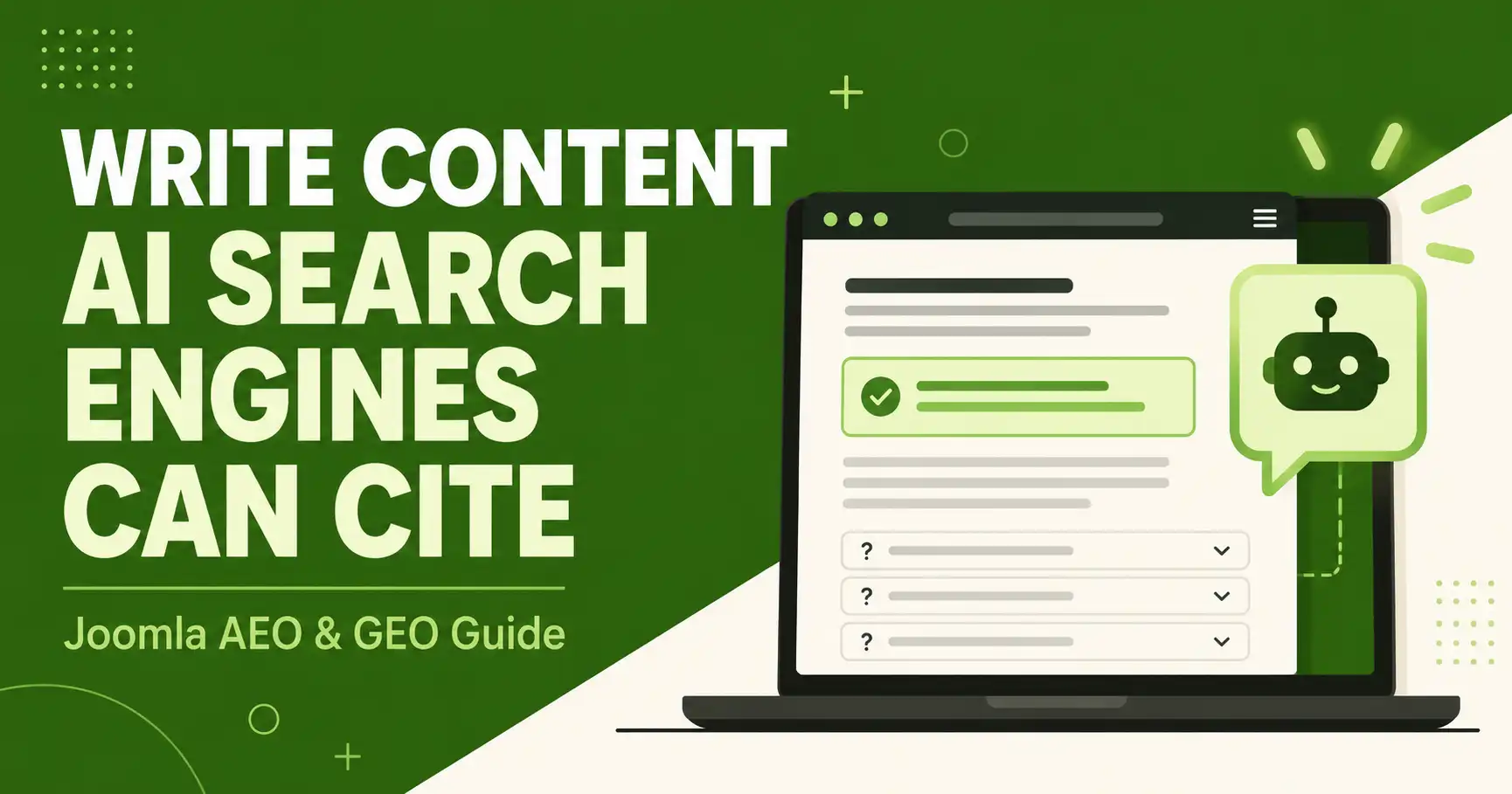
To make Joomla content citable by AI search engines (ChatGPT, Perplexity, Google AI Overviews), answer the reader's question in the first two sentences, keep that answer inside the Intro Text so it isn't hidden behind "Read more," fill in Joomla's native Meta Description field, and end with a short FAQ built from questions readers actually ask. Structured data (JSON-LD) still helps AI systems parse the page, even though Google removed the FAQ rich-result snippet from Search in May 2026.
| What you'll need | Notes |
|---|---|
| Joomla 5.4 LTS or 6.x | Backend screenshots and menu paths in this guide use Joomla 6.1 |
| Editor access to Content → Articles | Any user group with article edit permission |
| An SEO extension (optional) | 4SEO, EFSEO, or Route66 can automate canonical tags and some schema fields |
| A way to inject JSON-LD (optional) | A "Custom Code to Head" style plugin, or a field provided by your SEO extension |
| A short list of real reader questions | Pull from Google's "People also ask," search autocomplete, or your own comments/inbox |
This guide covers how to structure and format an article inside the Joomla editor so both readers and AI answer engines can find the point quickly. It does not cover URL structure or global metadata settings — those are covered in the linked articles at the end of this guide. Menu paths below match Joomla 6.1; Joomla 5.4 LTS uses the same labels in the article editor.
Step 1: Answer the Main Question in the First Two Sentences
Write the direct answer before any background, history, or "in this article we'll cover" preamble. An analysis of AI citation patterns by Superlines found that 44.2% of AI citations come from the first 30% of a page's content — the earlier the answer sits, the more likely it gets pulled into a generated response.
In Joomla, this means the Quick Answer box above should double as your article's Intro Text, not a separate teaser paragraph that gets discarded once you write the "real" introduction below it.
Step 2: Split Intro Text and Full Text Without Hiding the Answer
When editing an article in Content → Articles, the editor toolbar has a "Read more" button that inserts the Intro Text / Full Text divider. Category and blog-layout pages on your site usually display only the Intro Text, and some crawlers weight that portion more heavily too. Place the divider after your Quick Answer and prerequisites table, never before them — otherwise the part most likely to get cited sits on the page a reader (or crawler) never loads.
🖼️
SCREENSHOT NEEDED
Joomla article editor toolbar with the "Read more" divider icon highlighted, and the divider line visible in the article body placed after the Quick Answer block.
Step 3: Turn Number Headings Into Question or Command Headings
Headings like "1. Why X Matters" describe your outline, not what the reader typed into a search box. Rewrite them as the question or command a reader would actually use — "Why Does Meta Description Length Matter?" or "Fill In Joomla's Native Metadata Fields." Reserve numbered "Step 1 / Step 2" headings for content that is genuinely sequential, like this guide.
Apply headings from the editor's paragraph-style dropdown (usually labelled "Paragraph" or "Format") rather than just making text bold and larger — semantic <h2>/<h3> tags are what both search crawlers and AI parsers use to segment a page into answerable chunks.
🖼️
SCREENSHOT NEEDED
Joomla editor's Format/Paragraph style dropdown open, showing Heading 2 and Heading 3 options being selected for a line of text.
Step 4: Fill In Joomla's Native Metadata Fields
Open the article you're editing and switch to the Publishing tab. The Meta Description field there is what search engines and AI crawlers read when no better summary is available — leave it blank and Joomla (or the crawler) will auto-extract the first characters of your body text instead, which rarely reads well. Keep it under roughly 155–160 characters, written for a human, with your main topic near the start.
If a menu item also points to this article, its own metadata (Menus → your menu → the item → Metadata tab) can override the article's, so check both if the two ever seem inconsistent.
🖼️
SCREENSHOT NEEDED
Joomla article editor, Publishing tab, with the Meta Description field visible and filled in with sample text.
Step 5: Build a Real FAQ Section
Close the article with 4–6 questions pulled from language readers actually use — Google's "People also ask," your search console queries, or questions you've been asked directly. Each answer should open with the direct answer in the first sentence and stay under about 60 words; save nuance and caveats for the body above.
Why this still matters after May 2026
Google removed the FAQ dropdown rich result from Search results starting May 7, 2026, in three phases through August 2026. FAQPage structured data is still a valid schema, and it isn't disallowed — it simply no longer creates a visual accordion under your listing. A clean, honestly-answered FAQ section is still useful to readers, and it remains one of the easiest sections for AI answer engines to lift a direct quote from.
Step 6: Add Structured Data via JSON-LD
Paste the JSON-LD block (see the separate schema file) into a "Custom Code to Head" style plugin, or into whatever custom-field your SEO extension provides for per-article head code. Keep the markup honest: only include a FAQPage block if the visible page actually has that FAQ, and only include HowTo if the page is genuinely a sequence of steps — mismatched or padded schema is treated as a quality signal against the page, not a bonus.
🖼️
SCREENSHOT NEEDED
Settings screen of the Custom Code to Head Tag plugin (or equivalent SEO extension field) with a JSON-LD script block pasted into the code box.
Step 7: Mark Freshness and Keep It Updated
Add a short "Last verified on [version] — [month/year]" line near the end of the article, and keep dateModified in your schema separate from datePublished — update it only when you make a substantive change, not for typo fixes. Stale "last verified" dates are a trust signal in reverse: they tell both readers and AI systems the page may no longer match current software versions.
🧯 Common Mistakes to Avoid
Burying the direct answer under a long introduction instead of leading with it ·
Writing headings around your outline instead of the reader's actual phrasing ·
Reusing generic, one-size-fits-all FAQ questions instead of ones your readers actually ask ·
Leaving Meta Description blank and letting it auto-generate from body text ·
Adding FAQPage or HowTo schema to a page that doesn't actually contain a real FAQ or step sequence ·
Forgetting to update dateModified after an edit, leaving a stale "Last verified" date on the page
FAQ
Does FAQ schema still help my Joomla page rank in Google?
Not as a visible rich result — Google retired the FAQ dropdown snippet in May 2026. FAQPage markup is still valid and can help AI systems parse a genuine Q&A section, but it no longer changes how your listing looks in Google Search itself.
Where do I add a Meta Description in Joomla?
Open the article in Content → Articles, switch to the Publishing tab, and fill in the Meta Description field. If a menu item also links to the article, check that menu item's own Metadata tab too, since it can take priority.
Should the Quick Answer box replace my article's Intro Text?
Yes — treat them as the same thing. Write the direct answer as your Intro Text, then place the "Read more" divider after it, so the part most likely to be quoted is never hidden behind a click.
Do I need an SEO extension to do this in Joomla?
No, all of the steps above use Joomla's built-in editor and Publishing tab fields. An extension like 4SEO, EFSEO, or Route66 can automate canonical tags and some schema fields, but it isn't required to follow this guide.
How often should I update the "Last verified" date?
Update it whenever you make a substantive change — a version bump, a corrected step, new pricing. Cosmetic edits like fixing a typo don't need a new date.
Can I use HowTo schema for a general writing guide like this one?
Only if the page is genuinely structured as sequential steps, as this one is. If your article doesn't have real steps, skip HowTo rather than adding it for the sake of "more schema."
➡️ What's Next
How to Create SEO-Friendly URLs in Joomla · How to Optimize Meta Titles and Descriptions in Joomla · Best Joomla SEO Plugins: Automate and Improve Your SEO Workflow · Joomla SEO Checklist
✅ Last verified on Joomla 6.1.2 / 5.4.7 — July 2026

Thanh Le
Joomla Specialist & Technical Writer
Thanh Le is a Joomla expert and technical writer at Jlvextension.com, known for creating in-depth tutorials, extension reviews, and optimization guides. His work focuses on helping developers and webs